

To open a business bank account in Canada, you’ll need government-issued photo ID, proof that your business exists (a registration certificate or articles of incorporation) and, if you’re incorporated, your business number. If you live in Canada, most banks will let you do the whole thing online.
For most business owners, the process can often be completed quickly, but additional reviews may take longer depending on the ownership structure and bank requirements.
The longer version is where people get stuck. The name on the application doesn’t quite match the registration. Nobody drew up a resolution saying who can sign. A partner who owns 30% of the company is on a job site in Fort McMurray and can’t send ID.
None of it is hard, but any one of these can push your account back a week. This guide walks through what banks actually ask for, so you get it right the first time.
Opened a personal account before? Here’s what changes
If you’ve ever opened a bank account in Canada for yourself, you already know half the process. For personal accounts, Canadian banks generally require identity verification under federal requirements.
This commonly involves acceptable government-issued identification, with additional verification depending on the bank and circumstances.
One can be government photo ID; the other can be something like a utility bill, a CRA notice of assessment or a credit card statement. Many personal accounts do not require employment information or a large opening deposit, although requirements vary by financial institution.
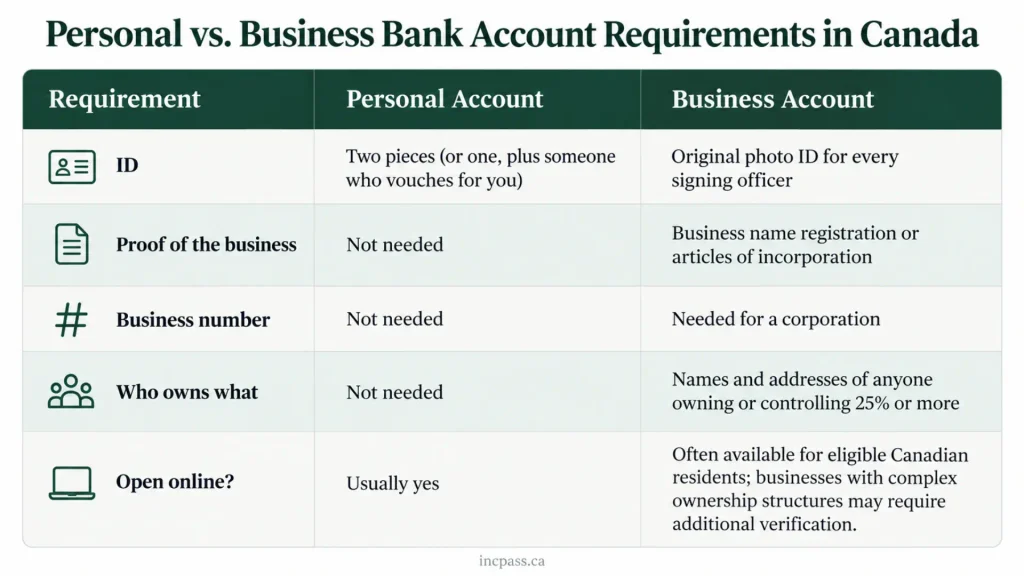
So if you’re asking what you need to open a bank account in Canada for your business, it’s your personal ID plus your business paperwork. The table below covers the paperwork.
Requirements to Open a Business Bank Account in Canada
Every bank asks each signing officer for one piece of original, valid government photo ID, such as a passport or driver’s licence. They’ll also take your full name, home address, date of birth, and occupation. After that, it depends on how your business is set up.
| How your business is set up | What to bring |
|---|---|
| Sole proprietor, trading under your own name (Jane Tremblay, not “Tremblay Renovations”) | Your photo ID. That’s often it, though some banks also ask for your Social Insurance Number (SIN). |
| Sole proprietor with a business name | Photo ID plus your provincial name registration, like Ontario’s Master Business Licence |
| Partnership | Photo ID for each partner who’ll use the account, plus your partnership registration or agreement |
| Corporation | Articles or certificate of incorporation, your list of directors, your business number, a resolution naming who can sign, and details for everyone owning or controlling 25% or more |
| Corporation in business for over a year | All of the above, plus something recent: a certificate of status, annual return or notice of assessment |
About that 25% rule
It catches people off guard, so it’s worth a minute. Under Canada’s anti-money-laundering requirements, financial institutions must collect beneficial ownership information, including individuals who own or control a significant percentage of a corporation (commonly 25% or more).
If your company is owned by a holding company, the bank will keep asking until it reaches actual people. Have those names and addresses ready, and your appointment will go much faster.
Quick tip: get your business number before you apply. Depending on where and how your corporation was registered, a Business Number may be assigned automatically by the CRA or may need to be obtained separately. It’s on your incorporation paperwork. [Link: business number vs corporation number]
Can I open a bank account online in Canada?
Yes, and for most Canadian business owners, it’s the easiest way to do it. Several major Canadian banks offer online business account applications, although availability depends on your business structure and eligibility. CIBC takes online applications for every type of business, from sole proprietors to corporations.
There’s a catch. To open a bank account online in Canada, you generally need to live here, or be here on a work or study permit, and agree to paperless statements. If you’d rather sit down with someone, book a branch appointment. Plan for every owner and signing officer to show up with original ID.
How do I open a bank account online in Canada?
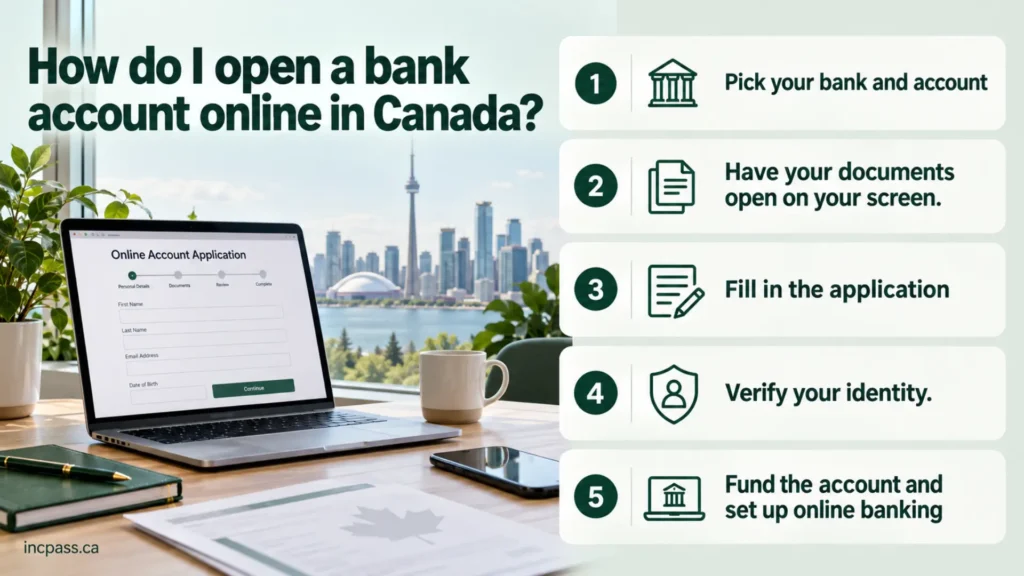
1. Pick your bank and account. Look at the monthly fee, how many transactions are included and e-Transfer limits (more on choosing below).
2. Have your documents open on your screen. You’ll upload or type in details from your registration or articles of incorporation, plus your business number.
3. Fill in the application, including every owner of 25% or more and every signing officer.
4. Verify your identity. Many banks let you do this on your phone with a photo of your ID. Others will ask you to confirm at a branch.
5. Fund the account and set up online banking, including who can approve payments.
That’s how to open a bank account in Canada online without leaving your kitchen table. Corporations with several owners sometimes get a follow-up call or a request to visit a branch, so leave yourself some slack before your first invoice goes out.
Don’t live in Canada? Plan for a branch visit
Non-residents may be able to open business accounts for Canadian corporations, although requirements and availability vary by bank. Online applications are often designed primarily for Canadian residents, while non-resident founders may need additional verification or an in-person process.
In practice, the signing officer flies in, visits a branch with original ID and the corporation’s documents, and signs in person.
Banks will also want a real Canadian business address; a PO box won’t cut it. If nobody can travel, call the bank before you apply and ask whether it accepts ID verified by a Canadian notary or at a foreign branch. Policies vary from bank to bank and change often.
What to Consider When Opening a Business Bank Account in Canada?
There are certain factors you must take into account before opening a business bank account, such as those mentioned below:
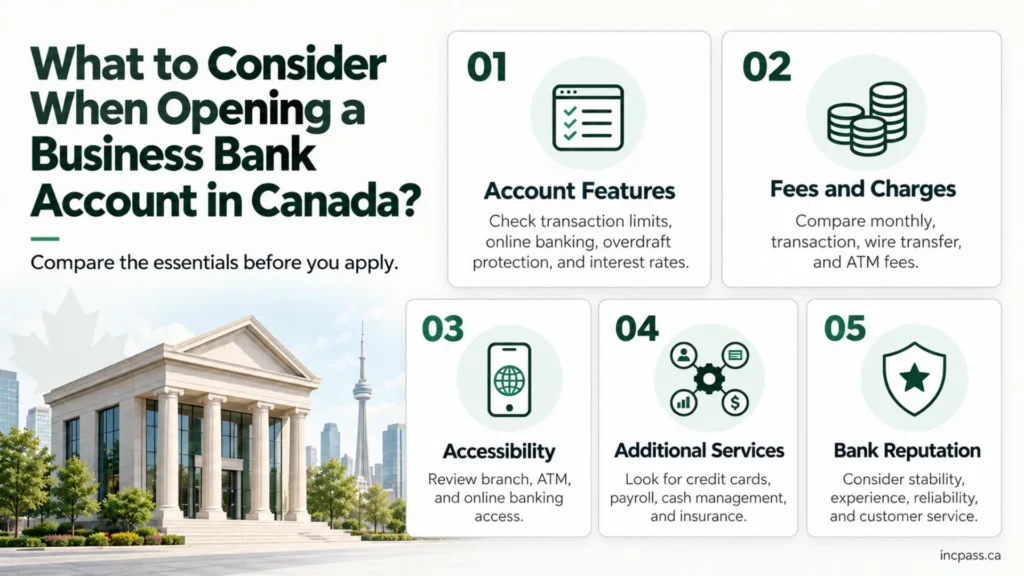
- Account Features: Consider whether the account’s transaction limitations, internet banking options, overdraft protection, and interest rates are suitable for your company’s needs.
- Fees and Charges: Compare account fees, including monthly maintenance fees, transaction fees, wire transfer fees, and ATM charges, to minimize banking costs.
- Accessibility: Evaluate the accessibility of branch locations, ATMs, and online banking platforms to ensure convenient banking services.
- Additional Services: Explore additional services offered, such as business credit cards, payroll processing, cash management solutions, and business insurance options.
- Bank Reputation: Investigate the standing and dependability of financial organizations, taking into account elements such as industry experience, stability, and high-quality customer service.
What’s the best bank to open a business account in Canada?
There is no single best bank for every business; the right choice depends on your transaction needs, location and business activities. The best bank to open a business account in Canada is the one that fits how money moves through your business.
- Mostly paid by e-Transfer or card? Focus on e-Transfer limits and fees, and on how many transactions the monthly plan includes.
- Handle a lot of cash (a restaurant, a shop, a food truck)? You need a branch nearby and a plan that doesn’t charge a fortune for cash deposits. Online-only accounts often can’t take cash at all.
- Invoice US clients or buy from US suppliers? A USD account at the same bank saves you a lot of conversion headaches.
- Based in Quebec? National Bank and Desjardins caisses are worth a look alongside the rest of the Big Six.
For a side-by-side comparison of the Big Six and the online options, see [Link: best banks in Canada for a new business].
Before you apply: a 5-minute checklist
Original photo ID for every signing officer
Registration certificate or articles of incorporation, with the exact legal name
Business number (corporations)
Director resolution naming who can sign
Names and addresses of everyone owning or controlling 25% or more
A Canadian business address (no PO boxes)
What to do after the Canadian bank account is open?
- Add the CRA as a payee in online banking. Corporate tax and GST/HST payments then take two minutes instead of a trip to the branch.
- Keep business and personal spending apart from day one. Your bookkeeper (and anyone reviewing your return at the CRA) will thank you.
- Tell the bank whenever directors, signing officers or anyone holding 25% or more changes.
Common Mistakes to Avoid When Opening a Corporate Bank Account in Canada
Avoid these common mistakes when opening a business bank account in Canada:
- Neglecting Research: Failing to research and compare different banking options may result in choosing a bank that doesn’t align with your business requirements.
- Partial Records: Providing erroneous or inadequate documentation might cause annoyance and prolong the account opening procedure.
- Ignoring Fees: Overlooking account fees and charges may result in unexpected expenses, impacting your business’s financial health.
- Mixing Personal and Business Finances: Combining personal and corporate funds can make financial reporting, tax filing, and accounting more difficult and cause compliance problems.
- Ignoring Bank Policies: Failing to understand and comply with bank policies and terms and conditions may result in account restrictions or penalties.
Conclusion
Opening a business bank account in Canada becomes much easier when your company documents and ownership details are properly prepared. Whether you operate as a sole proprietor, partnership, or corporation, having the right identification, registration documents, and ownership information helps avoid unnecessary delays.
The right banking option depends on your business needs, from transaction volume and payment methods to cash handling and international requirements. For entrepreneurs establishing a Canadian company, a properly structured incorporation and complete documentation provide a stronger foundation for a smooth banking setup and long-term business operations.
FAQs
What do you need to open a bank account in Canada?
In order to open a bank account in Canada, you need the following-
1. For a personal account, two pieces of ID, such as government photo ID plus a utility bill or CRA notice. You don’t need a job or an opening deposit.
2. For a business account, add proof that the business exists (a registration or articles of incorporation) and, for a corporation, its business number.
What are the requirements to open a business bank account in Canada?
Original photo ID for every signing officer, your business registration or articles of incorporation, and your business number if you’re incorporated.
Corporations also need to provide a list of directors, a resolution naming who can sign, and the names and addresses of everyone owning or controlling 25% or more.
Can I open a bank account online in Canada?
Yes. Most major banks let you open a bank account in Canada online, for personal or business use. You’ll generally need to live in Canada, or hold a work or study permit, and accept paperless statements.
How do I open a bank account online in Canada?
Choose your bank and account, apply on its website, enter your ID and business details, and verify your identity. Then fund the account. Sole proprietors are often done the same day; corporations with several owners can take a little longer.
What’s the best bank to open a business account in Canada?
It depends on how you get paid. Cash-heavy businesses need a branch nearby, e-Transfer-heavy businesses should compare transaction limits, and anyone billing US clients should look for a USD account.
In Quebec, National Bank and Desjardins are worth comparing with the other big banks.
Can a non-resident open a business bank account in Canada?
Often, yes, for a Canadian corporation they own. But online applications are usually limited to Canadian residents, so expect the signing officer to visit a branch in person with original ID.
Do I need a business number to open a business bank account?
Corporations generally require a Business Number for many banking and tax purposes, although the timing and process depend on how the corporation was registered.