
A business number (BN) is the 9-digit number the Canada Revenue Agency (CRA) uses to identify your business for tax. Registering for one is free. If you incorporate federally, or register or incorporate in most provinces, you get a BN automatically. Everyone else applies to the CRA online, by phone or by mail, usually when they first need a GST/HST, payroll or corporate tax account.
This guide covers how to get your BN and what to do with it. If you’re trying to work out whether your BN is the same as your corporation number, see our guide on business number vs corporation number.
Business Number in Canada at a Glance
- Issued by: the Canada Revenue Agency
- Format: 9 digits, for example 123456789
- Cost: free from the CRA
- Automatic for: federal corporations, and businesses registered or incorporated in AB, BC, MB, NB, NS, ON, PEI and SK
- Apply separately in: Quebec, Newfoundland and Labrador, Yukon, Northwest Territories and Nunavut
- Used for: GST/HST, payroll, corporate income tax and import/export accounts
What is a Business Number?
Your BN is one number for all your dealings with the CRA. On its own it doesn’t let you do much. Its job is to hold your program accounts, the separate accounts for each type of tax you deal with.
Each program account adds two letters and four digits to your BN. So if your BN is 123456789, your GST/HST account would be 123456789 RT0001.
| Program account | Code | You need it if you… |
|---|---|---|
| GST/HST | RT | Charge GST/HST on your sales |
| Payroll deductions | RP | Pay employees and remit income tax, CPP and EI |
| Corporation income tax | RC | Run a corporation |
| Import/export | RM | Bring goods into or ship goods out of Canada |
| Information returns | RZ | File certain information slips, like T5S |
You only open the accounts you actually need. A sole proprietor with no staff and sales under the GST/HST threshold may not need any at all.
Who Needs a Business Number?
According to the CRA, you need a BN when you:
• Incorporate a business
• Register for a GST/HST, payroll or other CRA program account
• Want to bid on federal government contracts
If you run an unincorporated business, such as a sole proprietorship or partnership, you only need a BN once you open your first program account. In practice, that’s usually when your taxable sales pass $30,000 and you have to register for GST/HST, or when you hire your first employee.
You may need a new BN if your business changes its legal structure, for example when a sole proprietorship becomes a corporation.
Do You Get a Business Number Automatically?
Often, yes. If you incorporate federally through Corporations Canada, you get a BN and a corporation income tax (RC) account without applying to the CRA. The same goes for registering or incorporating in eight provinces.
| Where you register | BN issued automatically? |
|---|---|
| Federal (Corporations Canada) | Yes, with an RC account |
| Alberta, British Columbia, Manitoba, New Brunswick, Nova Scotia, Ontario, PEI, Saskatchewan | Yes |
| Quebec | No. Apply to the CRA separately |
| Newfoundland and Labrador | No. Apply to the CRA separately |
| Yukon, Northwest Territories, Nunavut | No. Apply to the CRA separately |
Even when your BN arrives automatically, your other program accounts don’t. You’ll still need to register for GST/HST and payroll yourself if you need them.
How to Get a Business Number in Canada?
If your BN doesn’t come automatically, getting one takes about 15 minutes online once you have your details ready.
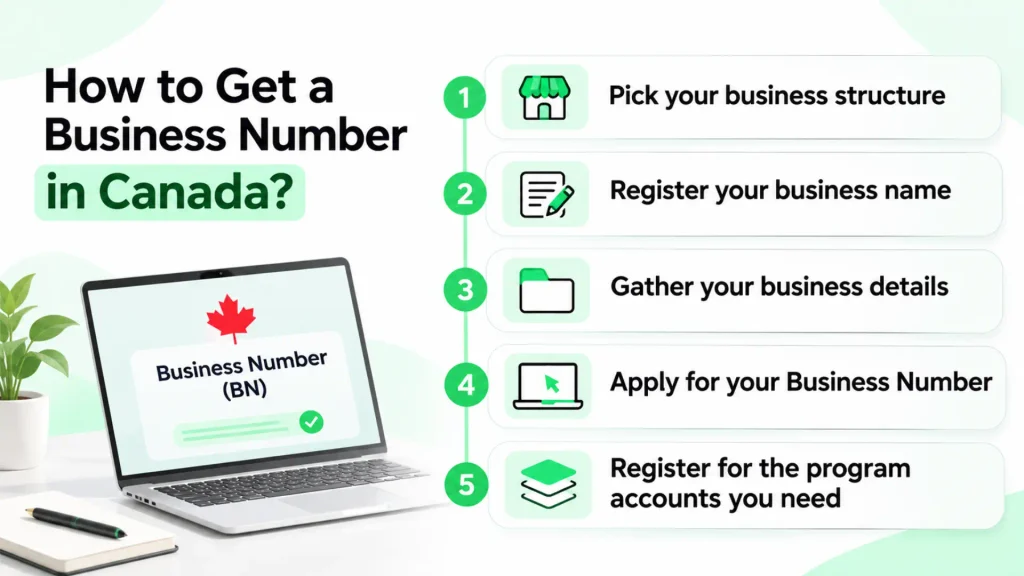
1. Pick your business structure
Sole proprietorship, partnership or corporation. This decides what information the CRA asks for, and changing it later can mean a new BN.
2. Register your business name
Depending on your province and business structure, you may need to register your business name before applying for a BN. Sole proprietors operating under a name other than their legal name generally need to check provincial registration requirements.
See our guide to registering a business name in Canada.
3. Gather your details
Prepare your legal business name, operating name (if applicable), business address, start date, primary business activity, and ownership information.
Canadian residents may need a valid Social Insurance Number (SIN) for online registration. Non-residents should follow the CRA’s separate registration requirements.
4. Apply for your Business Number
Visit the official CRA website and access Business Registration Online (BRO) through your CRA account.
If you’re unable to register online, you may be eligible to submit Form RC1 by mail. Non-resident businesses should follow the applicable CRA registration process.
5. Register for the program accounts you need
Depending on your business activities, you may need additional accounts, including:
- GST/HST (RT): For applicable sales tax obligations.
- Payroll (RP): If you have employees and payroll deduction obligations.
- Corporation income tax (RC): For incorporated businesses.
- Import/export (RM): Registered separately through the Canada Border Services Agency’s CARM system.
Once your BN is issued, keep it securely recorded. You’ll use it to identify your business when dealing with applicable government programs and CRA tax accounts. Banks may also request it when you open a business bank account.
Business Number Rules by Province
Your BN is federal, so it works the same everywhere. What changes from province to province is how you get it, which other numbers you’ll be given, and which sales taxes sit outside your BN.
Ontario
• You get a BN automatically when you register a business name or incorporate through the Ontario Business Registry.
• Don’t mix up your BN with your Ontario Business Identification Number (BIN). Ontario issues a BIN when you register a business name. It’s also 9 digits, but the province uses it, not the CRA.
• Ontario charges 13% HST, which you collect and file through your CRA RT account.
Starting out in Ontario? See how to register a company in Ontario.
British Columbia
• You get a BN automatically when you register or incorporate through BC Registries.
• BC charges 7% PST on top of the 5% GST. PST is not part of your BN. You register for it separately with the BC government.
• Your BC incorporation number comes from BC Registries and is different from your BN.
See our guide to business registration in British Columbia.
Alberta
• You get a BN automatically when you register or incorporate in Alberta.
• Alberta has no provincial sales tax, so most businesses only deal with the 5% GST through their RT account.
• Alberta collects its own corporate income tax, at a general rate of 8%. Your federal T2 doesn’t cover this, so Alberta corporations also file a provincial return.
See the starting a business in Alberta checklist.
Quebec
- Quebec doesn’t issue a BN when you register. You apply to the CRA separately.
- When you register with the Registraire des entreprises, you get a 10-digit Quebec Enterprise Number (NEQ). See how to get an NEQ in Quebec.
Other provinces and territories
- Manitoba and Saskatchewan: BN is issued automatically. Provincial sales tax is registered separately with the province.
- New Brunswick, Nova Scotia and PEI: BN issued automatically. HST is filed through your CRA RT account.
- Newfoundland and Labrador: HST province, but you apply for your BN with the CRA separately.
- Yukon, Northwest Territories and Nunavut: no territorial sales tax. Apply for your BN with the CRA separately.
How Much Does a Business Number Cost and How Long Does It Take?
The BN itself is free from the CRA. What costs money is everything around it, such as provincial name registration, incorporation filing fees, licences and any professional help.
How long you’ll wait depends on how you apply:
• Automatic (on incorporation or provincial registration): arrives with your registration
• Business Registration Online: usually issued straight away
• By phone: usually issued during the call, if you have your details ready
• By mail or fax (Form RC1): the slowest route, often several weeks
Common Business Number Mistakes
- Thinking your BN means you’re registered for GST/HST. It doesn’t. GST/HST is a separate RT account you have to open.
- Applying for a second BN. If you incorporated federally or in a province that issues one automatically, you already have one. A duplicate causes filing headaches.
- Missing the GST/HST threshold. Once your taxable sales pass $30,000 over four consecutive quarters, or in a single quarter, you have to register.
- Forgetting provincial sales tax. In BC, Manitoba and Saskatchewan, PST is registered with the province, not through your BN.
- Mixing up your numbers. Your BN, your corporation number and Ontario’s BIN are different things. Our business number vs corporation number guide explains which is which.
- Using the old BN after changing structure. Incorporating a sole proprietorship usually means a new BN for the corporation.
Conclusion
Your business number is the anchor for everything you do with the CRA. If you incorporate federally or in most provinces, it arrives automatically. If not, it’s free and quick to get online.
The part that trips people up is what comes next: opening the right program accounts, registering for GST/HST on time, and remembering provincial sales tax where it applies.
Incpass can handle your incorporation, BN and tax registrations together, so your business is set up properly from day one.
FAQs
Is a business number free in Canada?
Yes. The CRA doesn’t charge to issue a business number, whether you apply online, by phone or by mail. You only pay for related steps like incorporation or name registration.
Do sole proprietors need a business number?
Only once they open a CRA program account. most sole proprietors get one when they register for GST/HST or hire their first employee.
Is my business number the same as my GST/HST number?
Not quite. Your GST/HST number is your 9-digit BN plus “RT” and four digits, for example, 123456789 RT0001. The BN identifies your business, and the RT account is for GST/HST.
Can I use one business number for more than one business?
A BN belongs to a legal entity. As a sole proprietor, you generally use one BN for all your unincorporated businesses. Each corporation gets its own BN.
Can a non-resident get a Canadian business number?
Yes. Non-resident businesses can get a BN, usually to register for GST/HST or to run a Canadian corporation. If you incorporate a Canadian company, the BN normally comes with it.