


So you’ve decided to incorporate. Good call for most growing businesses. But “corporation” in Canada isn’t one thing. The type you end up with decides your tax rate, who can own shares, how much you disclose and, in a couple of cases, whether your personal assets are on the line.
Still choosing between a sole proprietorship, partnership or corporation? Start with our guide to types of companies in Canada, then come back here.
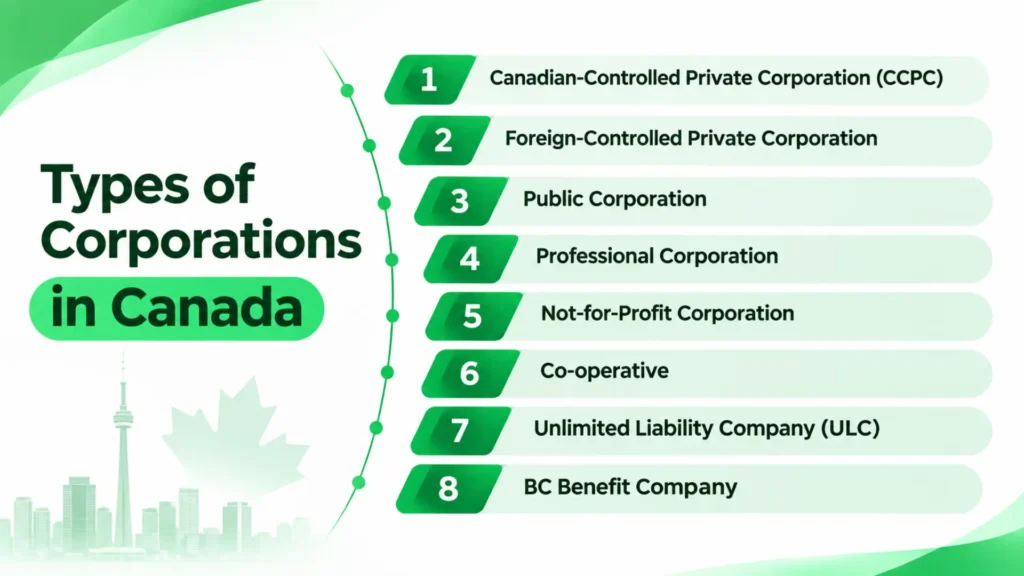
Quick answer: Most Canadian small businesses are Canadian-controlled private corporations (CCPCs). They pay a federal rate of 9% on the first $500,000 of active business income instead of 15%. The other main types are foreign-controlled private corporations, public corporations, professional corporations, not-for-profit corporations, co-operatives, unlimited liability companies (ULCs) and, in BC, benefit companies.
Types of Corporations in Canada at a Glance
| Type | Best for | Owned by | Federal tax on active business income |
|---|---|---|---|
| CCPC | Most Canadian small businesses | Mainly Canadian residents | 9% on first $500,000, then 15% |
| Foreign-controlled private corporation | Foreign founders, subsidiaries | Non-residents or foreign companies | 15% (no small business rate) |
| Public corporation | Companies raising money on a stock exchange | Public shareholders | 15% |
| Professional corporation | Doctors, lawyers, accountants and other regulated professions | Licensed members of the profession | 9% / 15% if it’s a CCPC |
| Not-for-profit corporation | Associations, clubs, community groups | Members (no shareholders) | Generally exempt if it qualifies |
| Co-operative | Member-run businesses (housing, farming, retail) | Members, one vote each | Taxed like a corporation |
| ULC | US parent companies | Usually a US entity | Taxed like any Canadian corporation |
| BC benefit company | Businesses with a public-benefit mission | Shareholders | Same as any BC company |
1. Canadian-Controlled Private Corporation (CCPC)
A CCPC is a private corporation that’s incorporated in Canada and isn’t controlled by non-residents, public companies, or a mix of the two. It’s what most people mean when they say “my corporation.”
Why it matters:
- Small business deduction: 9% federal tax on the first $500,000 of active business income, versus the 15% general rate
- Shared limit: associated corporations (say, two companies you control) share one $500,000 limit
- Investment income catch: the limit starts shrinking once the corporation earns more than $50,000 of passive investment income a year, and disappears at $150,000
- Other perks: access to the lifetime capital gains exemption on qualified small business shares, and enhanced SR&ED refunds for research spending
Watch out for: CCPC status depends on who controls the company, not just who owns it. A shareholders’ agreement giving a foreign investor control can cost you the 9% rate.
2. Foreign-Controlled Private Corporation
This is a private corporation controlled by non-residents or a foreign company. It’s the usual setup when you register a subsidiary in Canada, or a foreign founder owns most of the shares.
- It’s a regular Canadian corporation in every other way: limited liability, separate legal entity, same filings
- It pays the 15% general federal rate from the first dollar, because it isn’t a CCPC
- A non-resident can still be a minority shareholder in a CCPC, as long as Canadians keep control
Running a business here from abroad? See starting a business in Canada as a foreigner.
3. Public Corporation
A public corporation has shares listed on a Canadian stock exchange, such as the TSX, TSX Venture or CSE.
- Upside: you can raise money from the public and shareholders can easily sell their shares
- Downside: prospectus requirements, continuous disclosure, audited financials and oversight by provincial securities commissions
- Tax: no small business deduction, so active income is taxed at the 15% general federal rate
- Dividends: usually paid as “eligible dividends,” which get a larger dividend tax credit in the shareholder’s hands
Few businesses start here. Most go public years after incorporating as a private company.
4. Professional Corporation
Regulated professionals, such as doctors, dentists, lawyers and accountants, can practise through a professional corporation where their province and regulator allow it.
- Who can own it: usually only licensed members of the profession. Some provinces let family members hold non-voting shares, depending on the profession.
- Approval: you’ll need your regulator’s sign-off as well as the usual incorporation
- Tax: if it’s a CCPC, it gets the 9% small business rate, which lets you leave profits in the company and pay less tax now
- What it doesn’t do: it won’t protect you from personal liability for your own professional negligence. It can protect you from business debts like a lease or a line of credit.
- Income splitting: largely shut down since 2018 by the tax on split income (TOSI), which taxes most dividends paid to non-active family members at the top rate
5. Not-for-Profit Corporation
A not-for-profit corporation is set up for social, community, cultural or recreational purposes, with members instead of shareholders. You can incorporate federally under the Canada Not-for-profit Corporations Act or under your province’s own law.
- Profits stay in the organisation. They can’t be paid out to members.
- It’s generally exempt from income tax if it’s run exclusively for non-profit purposes
- It isn’t a charity. Only organisations registered with the CRA as charities can issue donation receipts. That’s a separate application.
6. Co-operative
A co-operative is owned and controlled by its members, who each get one vote no matter how many shares they hold. Co-ops are common in housing, farming, retail and credit unions.
- Incorporated federally under the Canada Cooperatives Act or under provincial co-op laws
- Taxed much like a regular corporation, but can usually deduct patronage dividends paid to members
- Works best when members are users of the business, not just investors
7. Unlimited Liability Company (ULC)
A ULC is a corporation whose shareholders can be personally liable for its debts. That sounds like a bad deal, and for most founders it is. ULCs exist for one main reason: US tax.
- Available in: British Columbia, Alberta, Nova Scotia and Prince Edward Island
- Who uses it: US companies setting up in Canada, because the US can treat a ULC as a flow-through entity
- In Canada: it’s taxed like any other Canadian corporation
- The catch: shareholder liability rules differ by province, and cross-border tax rules can cut the benefit. Get cross-border tax advice before choosing one.
8. BC Benefit Company
British Columbia lets a regular company adopt a public-benefit commitment in its articles. Directors must balance that commitment with shareholders’ interests, and the company publishes an annual benefit report.
It’s taxed like any other BC company. It suits social enterprises that want profit and purpose in one structure. Thinking of setting up in BC? Read: starting a business in British Columbia.
How to Choose the Right Type of Corporation in Canada?
Answer these in order, and the choice usually makes itself:
- Are you in a regulated profession? Check with your regulator. You may have to use a professional corporation.
- Is the goal profit or purpose? Purpose with no owners taking profits points to a not-for-profit. Profit plus a public mission in BC points to a benefit company.
- Who will control it? Canadians in control means a CCPC and the 9% rate. Foreign control means a regular private corporation at 15%.
- Is the parent a US company? Ask a cross-border tax adviser whether a ULC makes sense.
- Do members run it together? Consider a co-operative.
- Planning to list on an exchange? Start private anyway. You can go public later.
For most owner-managed businesses, the answer is a CCPC, often with a holding company above it once profits build up.
Conclusion
The type of corporation you choose shapes your tax bill and your paperwork for years. For most Canadian owners, a CCPC is the right start: limited liability and a 9% federal rate on the first $500,000 of active income.
Foreign owners, regulated professionals, non-profits and US parent companies each have their own route. Pick the structure that matches who owns and controls the business today, and where you want it to be in five years.
FAQs
What are the main types of corporations in Canada?
The main types are Canadian-controlled private corporations (CCPCs), foreign-controlled private corporations, public corporations, professional corporations, not-for-profit corporations, co-operatives and unlimited liability companies. BC also allows benefit companies.
What is a CCPC and why does it matter?
A CCPC is a private corporation incorporated in Canada and not controlled by non-residents or public companies. It matters because it can claim the small business deduction, paying 9% federal tax on the first $500,000 of active business income instead of 15%.
Can a non-resident own a Canadian corporation?
Yes. Non-residents can own 100% of a Canadian corporation. If non-residents control it, though, it isn’t a CCPC and pays the 15% general federal rate. Federal corporations also need at least 25% of directors to be resident Canadians.
Is a numbered company a different type of corporation?
No. A numbered company is a regular corporation that uses its registration number instead of a name. It has the same rights, liability protection and tax treatment as a named company.
Is a not-for-profit corporation the same as a charity?
No. A not-for-profit can be exempt from income tax, but only a charity registered with the CRA can issue donation receipts. Registering as a charity is a separate process with stricter rules.