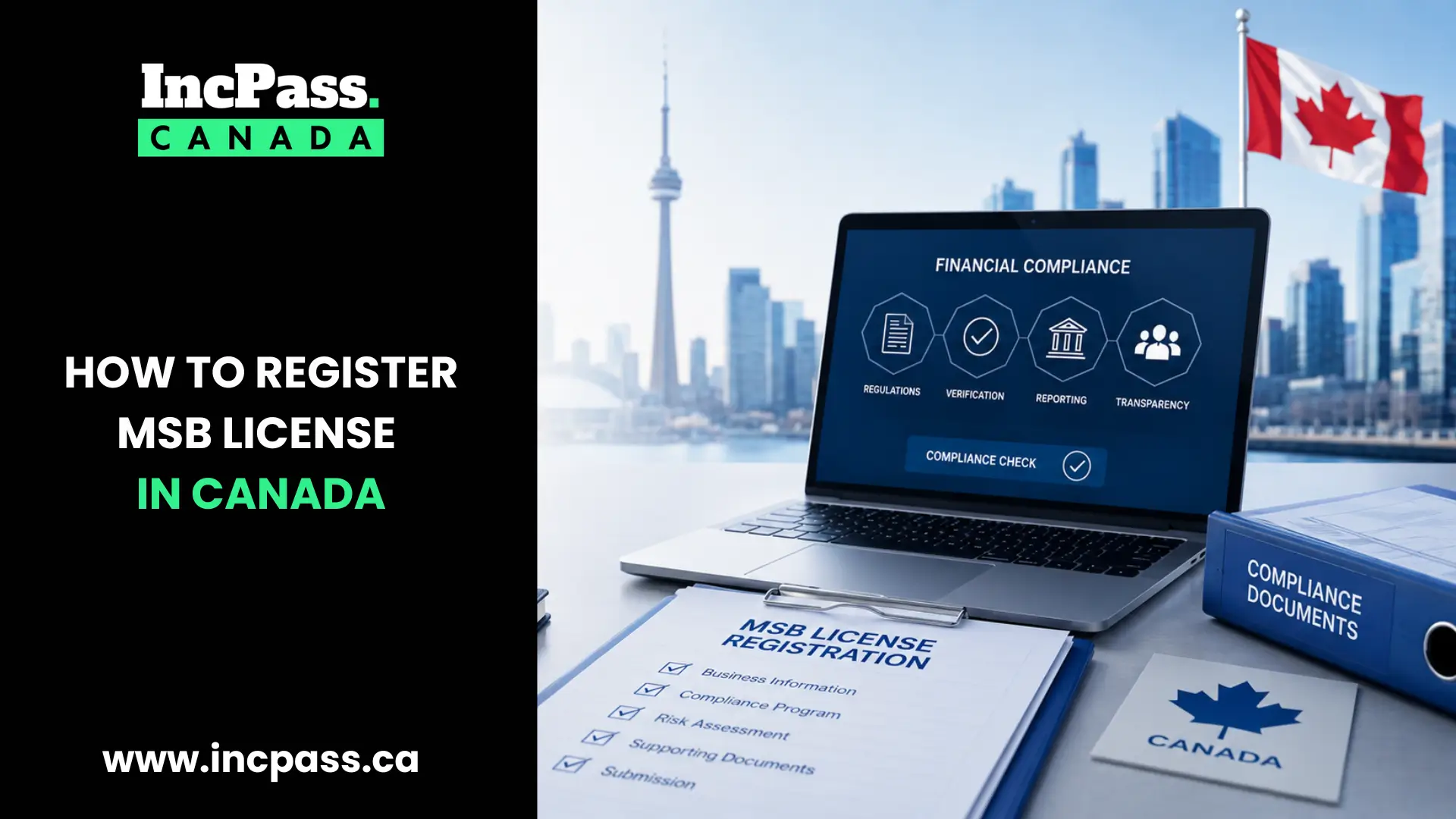

If you’re planning to start a business in Canada that deals with money transfers, currency exchange, or cryptocurrency services, there’s a strong chance you’ll need an MSB License in Canada. And if you’re unsure where to begin, you’re in the right place.
The process trips up a lot of business owners. The rules are strict, the compliance requirements are In-depth and the price of being wrong can be severe. However, if you Know how it operates, the path forward is actually pretty straightforward.
This guide covers everything you need to know about how to register MSB License in Canada, what is an MSB, how to get FINTRAC registration step-by-step, what documents are required, and what happens if you don’t register.
Whether you’re starting a fintech business or grow an existing business into financial services, this article is written for you.
What Is a Money Services Business License in Canada?
A Money Services Business (MSB) is any business that engages in certain financial services that are regulated by Canada’s Proceeds of Crime (Money Laundering) and Terrorist Financing Act (PCMLTFA).
Unlike a traditional banking license, a Canadian MSB License is not issued by a provincial body. It comes in the form of a mandatory registration with FINTRAC Canada’s Financial Transactions and Reports Analysis Centre, the federal agency responsible for the detection and prevention of money laundering and terrorist financing.
Here’s the key thing to understand: there is no fee to register. But operating without registration is a federal offence. The registration itself is free the compliance that follows it is where the real investment begins.
Types of MSB Activities
Under Canadian law, the following activities classify a business as an MSB:
- The trading of foreign currencies, both purchasing and selling.
- Funds or value transfer services, sending money domestically or internationally, including remittances
- The issuance or receipt of money order, travellers cheques, or similar items
- Dealing in virtual currencies buying, selling, or exchanging cryptocurrencies like Bitcoin or Ethereum
- Crowdfunding platform services platforms that facilitate fundraising involving payment flows
If your business performs even one of these activities — even as a secondary service — you are legally required to complete FINTRAC MSB Registration before you start operating.
Who Needs an MSB License in Canada?
The response is bigger than many would think. If you register as an MSB in Canada if you:
- Run a currency exchange kiosk or bureau de change
- Run a payment system that transfers funds on behalf of users
- Provide cryptocurrency exchange, brokerage, or wallet services
- Process cross-border payments or foreign remittances
- Run a crowdfunding platform that maintain payment processing
- Sell prepaid cards, money orders, or traveler’s cheques
Whether you’re a sole proprietor, a corporation or a funded start up, it doesn’t matter. The key is what kind of service you are providing.
One thing many businesses don’t realize: foreign companies that serve Canadian customers are also considered MSBs. Even when you do not physically have a presence in Canada, if you are based outside Canada and conduct MSB activities with Canadian residents, you will need to register as a Foreign MSB (FMSB) with FINTRAC.
How to Register MSB License in Canada: Step-by-Step
The FINTRAC MSB Registration process is fully electronic and completed via FINTRAC’s secure web portal. It works like this:
Step 1 — Create a FINTRAC Account
Register a business account on FINTRAC web reporting portal at fintrac-canafe.gc.ca. You will confirm your identity and will enter some basic business details to begin.
Step 2 — Complete the MSB Registration Form
The form asks you about your business structure, business ownership information, types of MSB activities you will provide, locations where you operate and information about your compliance officer. Please take your time here — if the form is not completed or inaccurate, your registration may be delayed, and it could be reviewed.
Step 3 — Designate a Compliance Officer
All MSBs in Canada are required to have a Chief Compliance Officer (CCO). This person will have responsibility for implementing and supervision of your AML/KYC program. They should be a senior member of your team who has legitimate authority, rather than just a title, to make compliance decisions.
Step 4 — Submit and Receive Your Registration Number
After receiving your application, FINTRAC will review it and provide you with your MSB Registration Number. Keep this safe. You’ll need it for regulatory filings and when opening business bank accounts — many banks will ask for it before onboarding an MSB client.
Step 5 — Build and Maintain Your Compliance Program
Registration is just the beginning. Once you’re registered, you must have a written compliance program in place covering risk assessment, policies and procedures, employee training, and record-keeping. This is not optional — and it’s where most businesses fall short.
Documents Required for MSB Registration
FINTRAC doesn’t require physical document uploads during the registration process, but you should have these ready before you start:
- Business registration certificate or articles of incorporation
- Beneficial ownership structure (who owns or controls the business)
- Government-issued ID for all directors and controlling persons
- Business address and contact details for all locations
- Description of all MSB activities you plan to offer
- Compliance officer’s name, title, and contact information
- A draft or finalized AML/KYC compliance program
FINTRAC can request any of these documents during an examination. Keeping them organized and accessible from day one will save you significant stress later.
FINTRAC Compliance Checklist for MSBs
Registration opens the door — compliance keeps you in business. After registering, your ongoing obligations include:
- Written Business specific compliance policies and procedures
- A risk assessment completed at least every two years (or when your business changes)
- A designated and adequately trained Chief Compliance Officer
- Annual AML/KYC training for all relevant employees
- Ongoing transaction monitoring and suspicious activity review
- Proper record-keeping most records must be retained for five years
- Filing Suspicious Transaction Reports (STRs) with FINTRAC when applicable
- Reporting large cash transactions (CAD $10,000 or more) within 15 calendar days of the transaction
- Reviewing and updating your compliance program annually
KYC & AML Requirements for MSBs
Know Your Customer (KYC) and Anti-Money Laundering (AML) requirements are the backbone of what FINTRAC expects from every registered Money Services Business in Canada.
KYC Requirements include:
- Verifying the identity of every client for transactions of CAD $1,000 or more
- Collecting and retaining government-issued ID details
- Screening clients against sanctions lists (including OSFI and OFAC)
- Conducting enhanced due diligence on Politically Exposed Persons (PEPs) and high-risk clients
AML Requirements include:
- A documented, risk-based AML compliance program
- Systems or processes to monitor transactions and flag unusual activity
- Clear internal procedures for escalating suspicious transactions
- Submitting FINTRAC reports within required timeframes
A weak AML/KYC program is one of the top reasons FINTRAC issues penalties to registered MSBs. Don’t see this as a ticking off exercise – it needs to be a true reflection of how your business works.
Common FINTRAC Compliance Mistakes
These are the most frequent errors MSBs make — and they’re all avoidable:
- Operating before registration is confirmed: Many businesses start accepting clients before their FINTRAC number comes through. This is illegal, full stop.
- No written compliance program: Registration without a documented program means you’re already non-compliant from day one.
- Failing to update FINTRAC within 30 days: Any change in ownership, business activities, locations, or your compliance officer must be reported promptly. FINTRAC doesn’t chase you for these missing them is your problem.
- Poor record-keeping: FINTRAC expects detailed records of transactions, client identification, and training logs. “We kept it in a spreadsheet” is rarely sufficient.
- Missing STR or LCTR deadlines: Suspicious Transaction Reports must be filed as soon as practicable after detection. Large Cash Transaction Reports must be filed within 15 calendar days.
- Untrained staff: Every employee who handles financial transactions must receive documented AML/KYC training. Good intentions don’t satisfy this requirement — records do.
How Much Does It Cost to Get an MSB License in Canada?
Here’s the good news: registering with FINTRAC is completely free. There is no federal registration fee for MSBs in Canada.
That said, running a fully compliant MSB has real operational costs you should plan for:
- Compliance consulting or legal fees to build your AML program: CAD $2,000–$15,000+
- KYC/AML compliance software CAD $500–$3,000+ per year depending on transaction volume
- Provincial licensing (where required) varies by province and activity type
- Compliance officer costs salary for an in-house CCO, or fees for outsourced compliance services
- Employee AML training programs CAD $500–$2,000+ annually
The registration itself costs nothing. The compliance infrastructure around it is where the real investment lies and it’s worth doing right.
How Long Does FINTRAC Approval Take?
For straightforward applications, FINTRAC confirms registration and issues your MSB Registration Number within a few business days of submission.
If your application is flagged for review due to incomplete information, complex ownership structures, or high-risk activity types it can take longer, sometimes several weeks.
The practical advice: don’t wait until your launch date to register. Start the process at least 4–6 weeks before you plan to begin operations, so you have time to finalize your compliance program alongside your registration without rushing either.
Penalties for Non-Compliance
FINTRAC doesn’t just send warning letters. Non-compliance with MSB registration and reporting obligations carries serious consequences under the PCMLTFA:
- Administrative monetary penalties (AMPs): up to CAD $100,000 per violation for persons and up to CAD $500,000 per violation for companies.
- Criminal charges: in serious cases, individuals can face up to five years in prison
- Public disclosure: FINTRAC publishes penalty notices on its website permanently and publicly which can damage your relationships with banks, payment processors, and partners
- Forced deregistration or business shutdown: FINTRAC has been increasingly active in enforcement. These aren’t theoretical risks.
Conclusion
Registering your MSB License in Canada is not the most complex process but it is one you cannot afford to get wrong. Every step counts from FINTRAC registration to the development of a compliant AML/KYC program. Compliance becomes a priority and becomes a habit from the moment the business begins, and it’s the businesses that do that who create long-terms credibility with banks, partners and clients and don’t incur penalties that could see the end of their credibility.
Looking to register your MSB in Canada and need expert guidance from start to finish, Incpass.ca will help you. Our team handles everything from FINTRAC registration to custom compliance programs so you can launch with confidence.
FAQ’s
Is cryptocurrency exchange considered an MSB activity in Canada?
Yes. As of 2014, and as further defined in the amendments to the PCMLTFA from 2019, firms involved in transactions with virtual currencies, such as virtual currency exchanges, over-the-counter desks and crypto ATM operators, are defined as MSB and are required to register with FINTRAC.
How often do I need to renew my MSB registration?
FINTRAC MSB registration does not expire. But your registration needs to be updated within 30 days of any significant change, such as a new MSB activity, change of ownership, new venue, or a new compliance officer.
What is the difference between an STR and an LCTR?
A Suspicious Transaction Report (STR) is filed when you have reasonable grounds to suspect a transaction is linked to money laundering or terrorist financing regardless of the amount. A Large Cash Transaction Report (LCTR) is filed for any single cash transaction of CAD $10,000 or more, within 15 calendar days.