
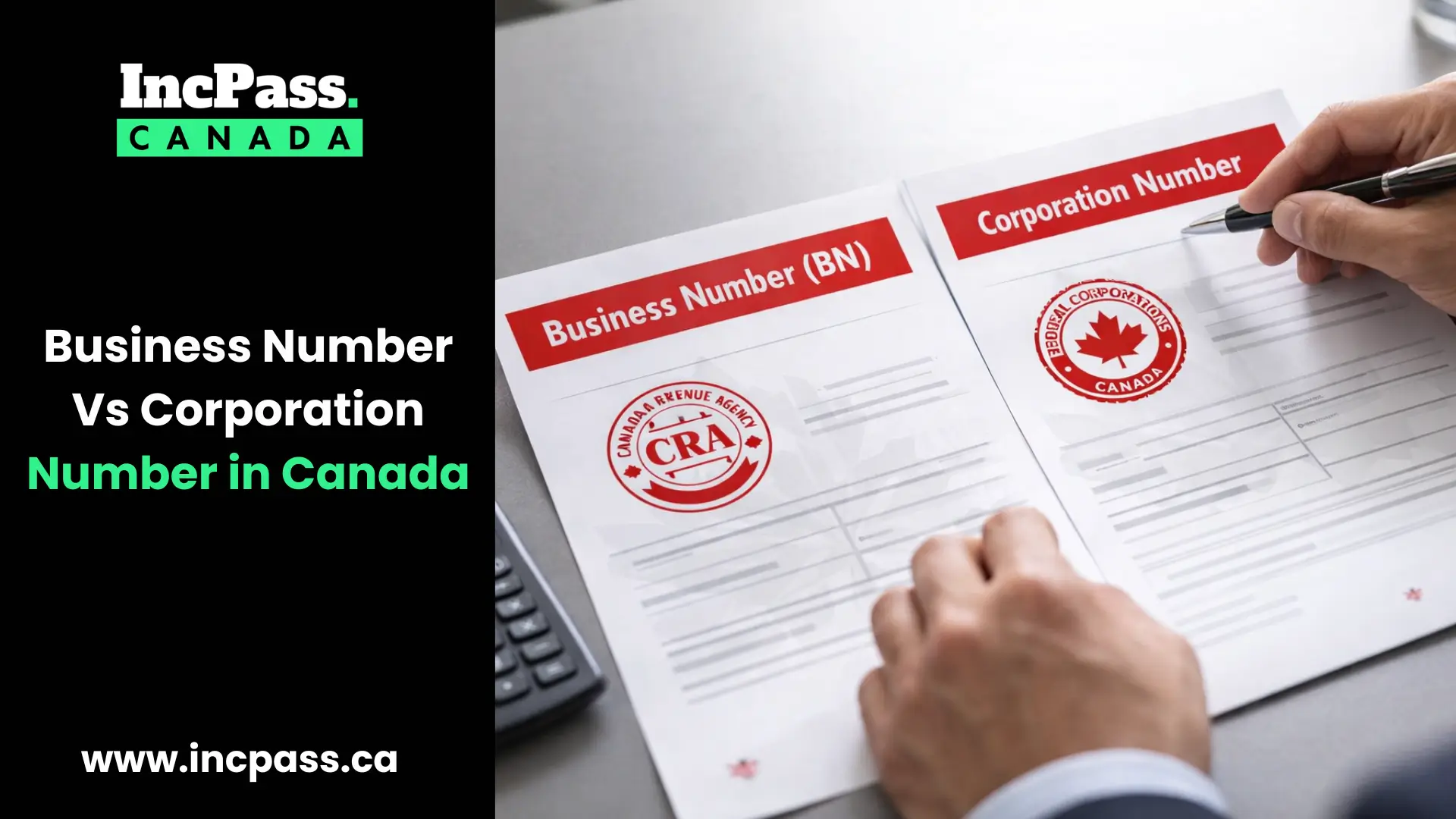

Operating a business in Canada requires more than incorporation — it requires correct identification under Canadian law and tax systems. One of the most common points of confusion for entrepreneurs is the difference between a Business Number vs Corporation Number in Canada.
With more than 3.26 million registered businesses in Canada, many founders mistakenly assume these identifiers are interchangeable. They are not. Each number is issued by a different authority, serves a different legal purpose, and applies at different stages of a business’s lifecycle.
Through this article, we will understand the difference between a business number and a corporation number in Canada, along with what it legally represents, and why most corporations need both is essential for tax compliance, banking, and lawful operations in Canada.
Business Number vs Corporation Number in Canada
A business number and a corporation number are not the same in Canada.
- A Business Number (BN) is a tax and government account identifier granted by the Canada Revenue Agency.
- A Corporation Number is a legal incorporation identifier issued when a corporation is created federally or provincially.
Most corporations in Canada have both. One does not replace the other.
What is a Business Number in Canada?
A Business Number (BN) is a 9-digit identifier assigned by the Canada Revenue Agency to track a business’s interactions with federal government programs.
It functions as a master tax ID, with extensions for specific accounts.
What is the Canadian business number used for?
- Corporate income tax (RC account)
- GST/HST (RT account)
- Payroll deductions (RP account)
- Import/export (RM account)
Example:
123456789 RT0001 → GST/HST account under the same BN
Key Characteristics
- Issued by CRA, not at incorporation
- Applies to sole proprietors, partnerships, and corporations
- Does not make a legal entity
- Required for ongoing tax and compliance obligations
What is a Corporation Number in Canada?
A Corporation Number is a legal identifier assigned when a company is incorporated under federal or provincial law. For federal corporations, it is granted by Corporations Canada.
What does the Corporation Number represent?
- Proof of legal incorporation
- Recognition as a separate legal entity
- Link to Articles of Incorporation and public records
Where is it used?
- Corporate filings and annual returns
- Legal contracts and share structures
- Due diligence and public registry searches
- Banking and institutional verification
A corporation exists legally because of the corporation number—not because of a BN.
Corporation Number vs Business Number: Clear Comparison
| Aspect | Business Number (BN) | Corporation Number |
| Issuing Authority | Canada Revenue Agency (CRA) | Federal or provincial/territorial authorities |
| Purpose | Taxation, government interactions | Legal identity, regulatory compliance, business transactions |
| Applicable Entities | Various business types (sole proprietorships, partnerships, corporations) | Specifically for corporations |
| Usage | Tax filing, permits, government programs | Regulatory compliance, business transactions, legal recognition |
| Legal Implications | Does not confer legal status or identity upon the business entity | Signifies legal existence and identity of a corporation as a separate legal entity |
Do You Need Both the Business Number and Corporation Number in Canada?
If You are a Corporation, then you need both the business number and the corporation number since:
- The Corporation Number proves your firm legally exists
- Business Number allows you to operate, invoice, hire, and pay taxes
If You Are Not Established:
- You may have a BN
- You will not have a Corporation Number
Conclusion
Understanding the difference between a business number and a corporation number is not a technical nuance — it is a foundational compliance requirement for operating in Canada.
A Corporation Number confirms that a business legally exists as a corporation under federal or provincial law. A Business Number, issued by the Canada Revenue Agency, enables that business to function operationally by meeting tax, payroll, GST/HST, and regulatory obligations. One establishes legal identity; the other enables lawful activity.
For incorporated businesses in Canada, both identifiers are required. They serve different authorities and compliance functions, and confusing them can lead to delayed tax filings or rejected banking applications. Contact Incpass to ensure your registration and compliance are handled correctly.
Frequently Asked Questions
Is a Business Number the same as a Corporation Number in Canada?
No. A Business Number is for taxation and government programs. A Corporation Number confirms legal incorporation.
Can I operate a corporation without a BN in Canada?
No. You may be incorporated, but you cannot meet tax or payroll obligations without a Business Number in Canada.
Does every business in Canada have a Corporation Number?
No. Only incorporated entities have a Corporation Number in Canada.