


Are you an entrepreneur contemplating establishing a new company or growing your current one in North America? Are you trying to find the best location for your business? Do you know that out of all the businesses registered every year, more than 20% of businesses fail within the first year of getting started? One of the reasons such a situation happens is because of choosing a bad location.
So if you are looking to grow your business in North America, then why not consider Canada for your business setup? Canada, a highly developed country with one of the biggest economies in the world, is situated in North America. Because of the country’s superior infrastructure and transportation, starting a business in Canada is advantageous for those wishing to expand and engage in commerce with neighbouring areas.
Whether you are an entrepreneur looking to register a company in Canada or expand your existing firm, this article will cover the procedure and benefits of registering your business in Canada successfully.
Reasons to Register a Company in Canada
Here are some of the reasons for company registration in Canada:
Treaty Protection Against Double Taxation
Canada and the United States have an income tax treaty that prevents the same income from being taxed twice, which matters if you are running cross-border operations or drawing income in both countries. Canada also maintains tax treaties with more than 90 countries, so most foreign founders arrive with a treaty already in place.
Low Corporate Tax Rates
A Canadian-controlled private corporation pays just 9% federal tax on its first $500,000 of active business income through the small business deduction, against a general federal rate of 15%. Once provincial tax is added, combined small business rates run from roughly 9% in Manitoba and Yukon to about 12.2% in Ontario and Quebec — and combined general rates from about 23% in Alberta to 31% in Prince Edward Island.
Canada’s statutory corporate rate of 26.0% sits mid-pack among G7 peers, which range from 25.0% to 36.1%. The more telling figure is the tax burden on new business investment: at 13.0%, Canada’s is the lowest in the G7 and well below the United States at 19.7%.
Economic Stability
Canada has held the lowest net debt-to-GDP ratio in the G7 for the past two decades — 11.9% in 2024, with the IMF expecting it to hold that position. It is a G7 economy with GDP of roughly $2.4 trillion and a population passing 41 million, and its services-led economy limits exposure to any single sector.
Preferential Access to Global Markets
A Canadian company is a launchpad, not just a domestic entity. Through CUSMA, it gets preferential access to a North American market of over 500 million consumers and more than US$30 trillion in combined GDP, with virtually tariff-free entry to the United States and Mexico. CETA adds the 27 EU member states, and the CPTPP adds 10 Indo-Pacific economies including Japan, Australia, Singapore and Vietnam.
Canada is the only country with a free trade agreement with every other G7 member.
Skilled Workforce
Canada has the most educated talent pool in the OECD: 65% of the population aged 25 to 64 has completed tertiary education. It is also unusually multilingual — close to 1 in 4 Canadians speaks one of over 200 languages in addition to English or French, which is a practical advantage if you are selling into overseas markets from a Canadian base.
Requirements to Register a Company in Canada
Before you file anything, it helps to know exactly what Canada expects of you. The requirements below apply to federal incorporation under the Canada Business Corporations Act (CBCA); provincial rules are broadly similar, with the differences noted where they matter most.
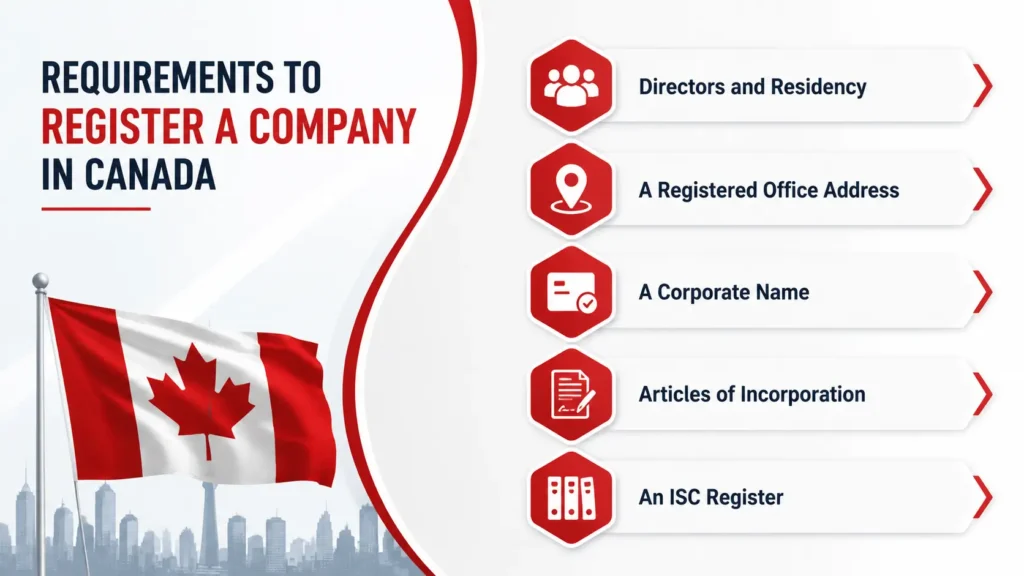
Directors and Residency
Your corporation needs at least one director. For a federal corporation, at least 25% of directors must be resident Canadians — and where there are fewer than four directors, at least one of them must be a resident Canadian.
This is the single requirement that most often redirects foreign founders away from the federal route. British Columbia, Alberta, Ontario and Quebec impose no director residency requirement, which is why non-resident entrepreneurs frequently incorporate provincially instead.
A Registered Office Address
Every corporation must maintain a registered office at a physical street address inside the province or territory named in its articles. A post office box alone is not acceptable. This is the address where official government and legal correspondence is delivered, and where your corporate records are kept.
A Corporate Name
You need either an approved word name or a numbered name. A word name requires a name search report; a numbered corporation skips that step entirely. The next section covers this in full.
Articles of Incorporation
Your articles set out the corporate name, the share structure, the number of directors, and any restrictions on business activity. Federal articles may be filed in English, French, or both.
An ISC Register
Since 22 January 2024, private federal corporations must maintain a register of Individuals with Significant Control — broadly, anyone holding or controlling 25% or more of the voting shares, or who exercises control in fact. This information is submitted to Corporations Canada at incorporation, refiled with each annual return, and updated within 15 days of any change. Ontario corporations must keep an equivalent transparency register at their registered office.
Treat this as a real obligation rather than paperwork: penalties for knowingly failing to comply are severe, and much of the federal ISC data is now publicly searchable.
How to Register a Company in Canada?
The procedure to open a company in Canada may change based on the province or area in which you intend to establish your business. It is important to conduct research on the legislation of your individual province to ensure that you fulfill the unique criteria.
Here is a general step-by-step approach for Canada company formation:
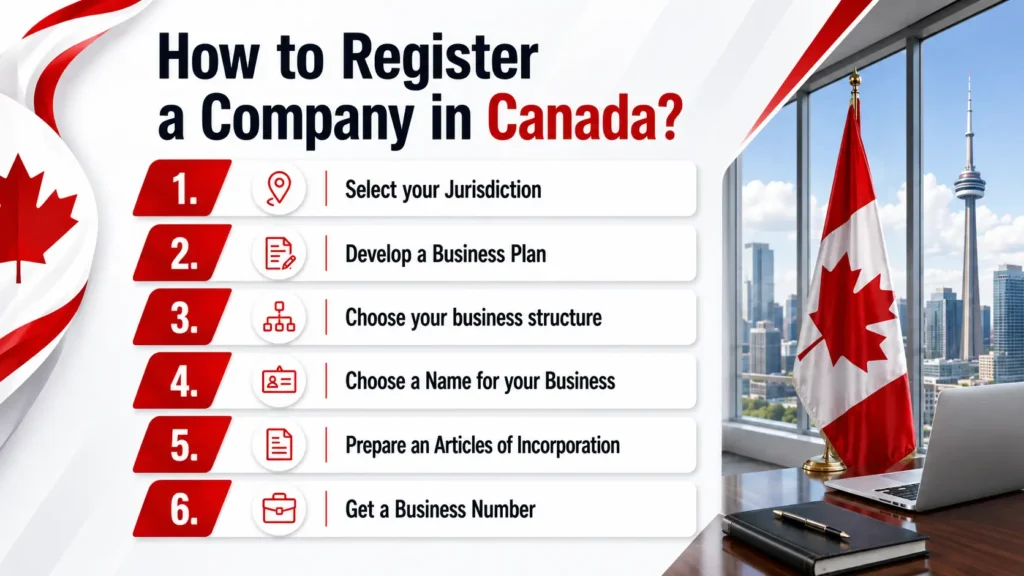
1. Select your Jurisdiction
One of the most crucial phases to open a company in Canada is choosing the location for business registration. There are two basic options to register your business in Canada: federal or provincial incorporation. Federal incorporation provides countrywide name protection and may be suitable if you want to operate across provinces. However, provincial incorporation might be speedier and less expensive, particularly if you want to stay local.
2. Develop a Business Plan
A well-crafted business plan serves as a roadmap guiding entrepreneurs through the intricacies of business operations and growth. Key components of a comprehensive business plan include defining business objectives, delineating target markets, conducting competitive analysis, and formulating robust marketing and financial strategies. By articulating a compelling vision and delineating clear action plans, entrepreneurs can instill confidence in stakeholders and set the stage for sustainable growth.
3. Choose your business structure
The third step to register a company in Canada involves selecting the most ideal legal structure for your business needs.
Note that each business structure has their own tax laws.
Here are the three main types of legal structures for a business:
Sole Proprietorship
Sole Proprietorship in Canada is the most straightforward structure to form, which is why most new and small businesses prefer it. Simply put, you are personally accountable for any obligations that the firm incurs. Your company’s financial information must be recorded in a separate part of the personal income tax form.
Corporation
A corporation in Canada is the most involved structure since its inclusion in the incorporation of a business, which results in the formation of a separate legal entity controlled by its stockholders. If you own a corporation, you are often given a salary similar to your employees.
Partnership
A partnership is as similar as sole proprietorship, except that there are two or more owners. This implies you have additional partners that share ownership of the firm with you. Being in a partnership necessitates a formal agreement that specifies each partner’s (in percentage) share of revenue, costs, and obligations. This proportion should be used for submitting taxes as well.
4. Choose a Name for your business
The business name symbolizes the business you run, and selecting the correct business name is a difficult but vital task.
If you run a sole proprietorship, you are not required to register a business name, but if you operate a corporation, you are liable to register your business name in Canada.
5. Prepare Articles of Incorporation
Basic incorporation can simplify the process of forming a business. This consists of predefined articles of incorporation, which often allow for later changes. Incorporation also includes one or two classes of shares, up to 10 directors, and a numbered corporate name.
However, for individuals who prefer a more personalized approach, creating articles of incorporation is a possibility. This allows you to set the corporation name, share structure, director numbers, and any other limits on business activity. Additional provisions can be added as needed. Notably, articles of incorporation can be produced in English, French, or both languages simultaneously, allowing for Canada’s linguistic diversity.
6. Get a Business number
Every incorporated business requires a business number (BN), a unique 9-digit ID provided by the Canada Revenue Agency (CRA). Think of it as your company’s social security number for tax reasons. Typically, you will acquire your BN automatically throughout the incorporation procedure.
This BN is required for filing taxes, collecting GST/HST (sales tax), and dealing with numerous government programs. So, incorporating and obtaining a BN are synonymous – your formal authority to operate and handle your business funds in Canada.
How to Register a Company Name in Canada
In Canada your corporate name is approved as part of incorporation, not through a separate filing. Here is what that involves.
1. Decide Between a Named and a Numbered Corporation
A numbered corporation is assigned a name automatically at incorporation — for example, 12345678 Canada Inc. It is faster, cheaper, and skips the name search entirely. A word name, such as Maple Leaf Technologies Inc., requires approval but gives you a brand you can actually market.
2. Run a Name Search
Outside Quebec, this means a NUANS report — a search comparing your proposed name against existing corporate names and trademarks across Canada. NUANS reports are produced by private search firms authorised by Corporations Canada, and a report generally must be less than 90 days old when you file.
Quebec is the exception: name availability there is handled through the Registraire des entreprises rather than NUANS, and Quebec names must comply with the province’s French language requirements.
3. Know What Your Name Protection Covers
Federal incorporation gives your name protection across Canada. Provincial incorporation protects it only within that province, which means an identical name may be registered elsewhere.
Either way, a corporate name is not a trademark. Registering a company name stops another corporation from registering a confusingly similar name in the same jurisdiction; it does not give you exclusive rights to use that name commercially. If the name is central to your brand, register a trademark in Canada as a separate step.
4. Register an Operating Name
If your corporation trades under any name other than its exact legal name, you must register that operating name in each province where you use it — numbered corporations almost always need one. See our guide to business name registration in Canada for the provincial detail.
Need Help With
Register your business in Canada with expert guidance. We simplify company incorporation, GST registration, Business Number (BN), and annual compliance.
Talk to an Expert →Post-Incorporation Requirements to Register a Company in Canada
Register GST/HST
Incorporating your business may affect your GST/HST registration. While incorporation does not need required registration, if your yearly turnover reaches $30,000, you must register for GST/HST. This allows you to collect sales tax and then claim it back on business purchases.
What is the good news? Incorporation can make filing easier because you’ll file GST/HST returns alongside your company income tax return.
Open a Business Bank Account
After you register a company in Canada, you need to open a business bank account in Canada to streamline financial transactions and enhance financial transparency. In order to open a bank account, you must evaluate banks with various banking options based on factors such as fees, accessibility, and additional services offered.
Annual Compliances
As a registered business, you’re required to meet annual compliance obligations, including filing annual returns, updating corporate records, and paying applicable taxes and fees.
Effortlessly navigate the intricate process of registering a company in Canada with the seamless support of Incpass. Our all-inclusive platform streamlines every procedure, ensuring a smooth and efficient registration procedure.
Benefits of Company Registration in Canada
There are ample benefits of company registration in Canada which are listed below:
- Limited Liability Shield: Incorporation creates a separation between your personal assets and your business’s finances. If your company faces debts or lawsuits, your personal belongings like your house or car are generally protected.
- Tax Advantages: Corporations have their own tax structure, often with lower rates than personal income tax. Plus, you can retain profits within the corporation and only pay tax when you withdraw them as salary.
- Easier Fundraising: Investors often prefer incorporated businesses, making it easier to raise capital for growth. This opens doors to venture capitalists, angel investors, and issuing shares.
- Enhanced Credibility: An incorporated business projects a more professional image, boosting trust with clients, partners, and potential investors.
Conclusion
Company registration in Canada is a strategic step towards establishing a thriving business in a thriving as well as prosperous market. Whether you’re a local entrepreneur or an international investor, Canada offers a welcoming environment and abundant opportunities for growth and success. By understanding the registration process, choosing the right business structure, and fulfilling post-incorporation obligations, you can set a solid foundation for your business journey in the land of maple leaves and endless possibilities.
Discover the seamless convenience of registering your business presence in Canada with Incpass. Our innovative platform empowers entrepreneurs to effortlessly initiate their business setup process from any location, at any time. With Incpass, every step is automated and simplified, guaranteeing a simple registration process. Begin the process of launching your Canadian company today by registering with Incpass. Contact us at Incpass.
FAQs
How much does it cost to register your business in Canada?
The cost of registering a business in Canada varies by province or territory, as well as corporate structure. Compared to corporations, single proprietorships and partnerships are less expensive to register.
1. British Columbia: The fee for establishing a business in British Columbia is $350 CAD. A $30 CAD charge is also required for name approval, along with your articles of incorporation.
2. Alberta: The cost of incorporation in Alberta is $275 CAD, plus a $30 name approval charge.
3. Ontario: The cost of incorporating a business in Ontario online or by mail is $300 CAD. Registering your business name incurs an extra $60 charge.
4. Quebec: Incorporation in Quebec costs $397 CAD, plus $27 to reserve a name (Registraire des entreprises rates in effect since 1 January 2026).
How do I register a corporation name in Canada?
Here’s the breakdown on registering a corporation name in Canada:
1. Choose a Unique and Available Name: Brainstorm a name that reflects your brand and isn’t already trademarked. Use a NUANS name search to check availability. NUANS reports are supplied by private search firms authorised by Corporations Canada, not issued by Corporations Canada directly.
2. Federal vs. Provincial Incorporation: Decide if you want to incorporate federally or provincially. Federal incorporation offers national name protection, while provincial incorporation offers protection within that specific province.
3. Name Registration During Incorporation: The name registration typically happens during the incorporation process itself. When filing your Articles of Incorporation (federal) or Notice of Intention to Apply (provincial) with the appropriate government agency, you’ll propose your chosen name.
What documents do I require to register my Canadian firm?
The documents required to register your Canadian firm vary depending on the nature and structure of the firm. To register a corporation, you will require articles of incorporation, business formation documentation, and, in some cases, a name search report.