

To register a trademark in Canada, you search the CIPO database to confirm your mark is available, prepare an application specifying your goods and services under the Nice Classification system, file it online with the Canadian Intellectual Property Office (CIPO), and pay CAD $491 for your first class of goods or services. As of 2026, due to CIPO’s application backlog, the full process from filing to registration typically takes 36 to 48 months.
Below is a complete breakdown of what a trademark protects, what it costs, how long it takes, and exactly how to file — step by step.
What is a Trademark?
A trademark is a word, design, slogan, sound, or other sign that legally distinguishes your business’s goods or services from those of everyone else in the marketplace. Once registered, it gives you exclusive rights to use that mark across Canada and legal grounds to stop others from using something confusingly similar.
Canada recognizes several types of trademarks:
- Word marks — A name, phrase, or slogan in plain text (e.g., a business or product name)
- Design marks — A logo, stylized text, or graphic
- Certification marks — Used to show goods or services meet a defined standard (for example, a “Made in Canada” certification symbol or a materials/quality standard mark)
- Non-traditional marks — Canada also permits registration of colours, three-dimensional shapes, holograms, moving images, sounds, tastes, scents, and textures, provided they meet distinctiveness requirements
Related reading: Register Your Business in Canada
Trademark vs. Business Name Registration: They Are Not the Same Thing
This is one of the most common points of confusion for new business owners.
A Canadian business name (or trade name) is the legal name you operate under. Registering it satisfies a legal requirement if you’re doing business under a name different from your own legal name or your corporation’s registered name — but it does not give you any exclusive rights to that name outside your own province or against competitors using something similar.
A trademark protects the brand elements customers actually associate with your goods or services — your name, logo, slogan, packaging, or other identifiers — and gives you exclusive, nationwide rights to them.
Key points:
- Business name registration is a legal/administrative requirement if you’re operating under a name other than your own legal name.
- Trademark registration is a strategic choice that prevents competitors from copying your branding nationwide.
- An unregistered business name can function as an unregistered trademark, but you get none of the legal advantages of registration.
- Without a registered trademark, you cannot stop another business from registering a similar name or logo as their own trademark — even if you used it first in your local market.
Trademark vs. Patent vs. Copyright
| Trademark | Patent | Copyright | |
|---|---|---|---|
| Protects | Your brand and the specific goods/services tied to it | New inventions and improvements to existing ones | Original creative works — art, music, writing, software |
| Requirement | Must be distinctive and specific to your brand | Must be novel, useful, and non-obvious | Must be original and fixed in some tangible form |
| What it gives you | Exclusive ownership of your branding | The right to stop others from making, using, selling, or importing your invention | Rights over reproduction, distribution, performance, and display |
| Duration | 10 years, renewable indefinitely | 20 years from filing, non-renewable | Life of the author plus 70 years |
Why Register a Trademark in Canada?
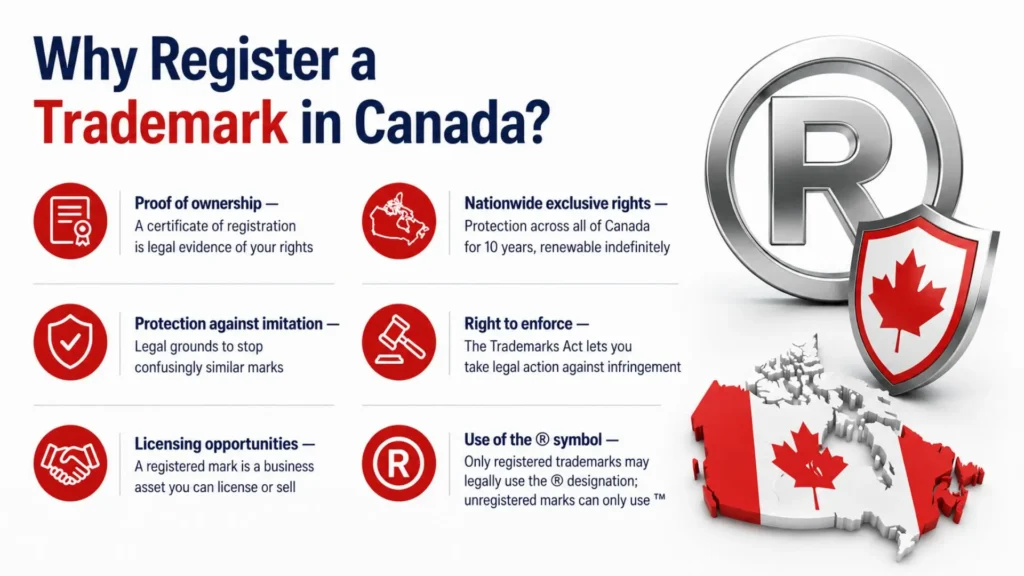
- Proof of ownership — A certificate of registration is legal evidence of your rights
- Nationwide exclusive rights — Protection across all of Canada for 10 years, renewable indefinitely
- Protection against imitation — Legal grounds to stop confusingly similar marks
- Right to enforce — The Trademarks Act lets you take legal action against infringement
- Licensing opportunities — A registered mark is a business asset you can license or sell
- Use of the ® symbol — Only registered trademarks may legally use the ® designation; unregistered marks can only use ™
Who Can Apply?
Any individual, partnership, corporation, trade union, or association can apply to register a trademark in Canada — including sole proprietors and unregistered businesses.
If you’re applying from outside Canada, you don’t need a Canadian address to file, but you’ll generally need to appoint a licensed Canadian trademark agent to represent you before CIPO and to receive official correspondence on your behalf. Most foreign applicants use a local agent regardless, since it materially reduces the risk of procedural errors and delays.
What Cannot Be Trademarked in Canada?
The Trademarks Act specifically excludes the following from registration:
- Names and surnames, unless they’ve acquired distinctiveness through use (a “secondary meaning”) in the public mind
- Clearly descriptive marks (terms that simply describe the product, like “Fast Delivery” for a courier service)
- Deceptive or misleading marks
- Marks that indicate a place of origin where the goods don’t actually originate
- Words that are simply the translation of a descriptive or generic term in another language
- Marks that are confusing with, or too similar to, existing registered trademarks
- Marks identical or similar to prohibited symbols — government insignia, official badges, Royal or state emblems, and similar protected marks
How Much Does It Cost to Register a Trademark in Canada (2026)?
CIPO fees are adjusted annually under the Service Fees Act. As of January 1, 2026, fees increased 2.7% from 2025 levels.
Current CIPO government fees (2026):
- First class of goods or services: CAD $491
- Each additional class: CAD $149
These are government filing fees only, paid directly to CIPO. If you hire a trademark agent or lawyer to prepare and file on your behalf, expect to budget an additional $1,000–$2,500 CAD or more in professional fees, depending on complexity.
Fees also apply later in the process for things like responding to an examiner’s report or for opposition and renewal proceedings — these are separate from the initial filing fee.
Because CIPO adjusts fees annually, always confirm current amounts on CIPO’s official fee schedule before filing.
How to Register a Trademark in Canada?
Listed below are the steps for trademark registration in Canada:
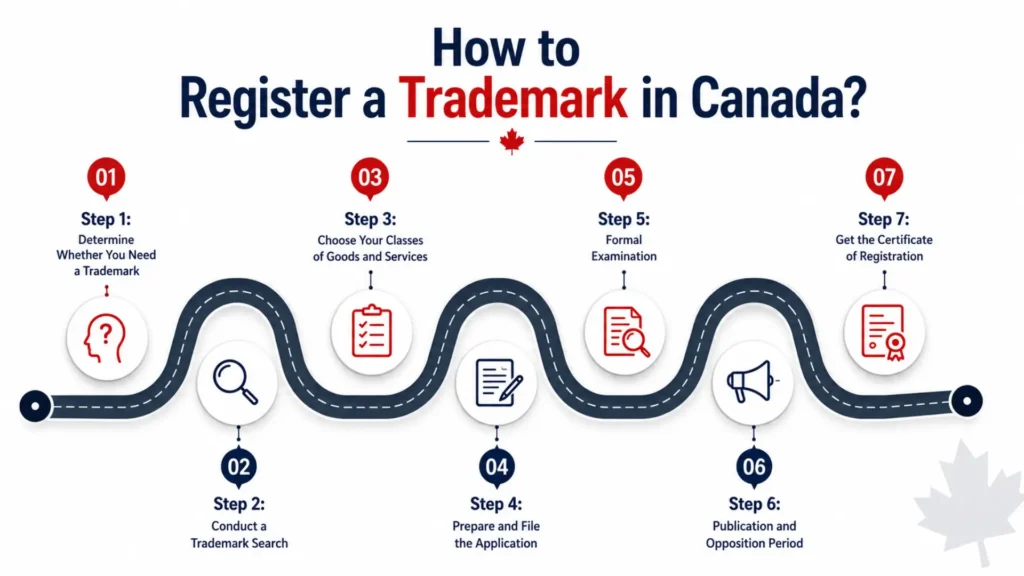
Step 1: Determine Whether You Need a Trademark
Registration isn’t legally required — using a mark in commerce gives you limited common-law rights automatically. But common-law protection is narrow, hard to enforce, and expensive to defend if challenged.
If your brand name, logo, or slogan is core to your business identity, or if you plan to expand beyond your local market, registration is worth the investment.
Step 2: Conduct a Trademark Search
Before filing, search the Canadian Trademarks Database to check whether your proposed mark is already registered, pending, or confusingly similar to an existing mark. This step significantly reduces your risk of refusal or opposition later in the process.
Many applicants also search business name registries and common-law use, since an unregistered mark already in active use can still block your application.
Step 3: Choose Your Classes of Goods and Services
Trademarks are registered against specific classes of goods and/or services under the Nice Classification system (an international standard with 45 classes). Your application must accurately list every class relevant to what you sell — this determines both your fee and the scope of your protection.
If you sell products in one class and offer services in another (for example, clothing plus retail services), you’ll need to include and pay for both.
Step 4: Prepare and File the Application
Your application must include a clear representation of the trademark, a precise description of the goods/services it covers by class, and your applicant details. Applications are filed online through CIPO. No power of attorney is required to file, but foreign applicants without a Canadian address typically need a licensed agent.
Step 5: Formal Examination
Once filed, a CIPO examiner reviews your application for compliance with the Trademarks Act and Trademarks Regulations, and searches the register for conflicting marks. If issues are found, CIPO issues an examiner’s report, and you (or your agent) have a set period to respond with amendments or arguments.
Step 6: Publication and Opposition Period
If your application passes examination, it’s published in the Trademarks Journal for a two-month period during which any third party can oppose your registration if they believe it conflicts with their own rights. If no opposition is filed — or if an opposition is resolved in your favour — your application proceeds to registration.
Step 7: Get the Certificate of Registration
Once your application clears opposition, CIPO registers the mark, and you’re issued a certificate of registration. You may now use the ® symbol. Your registration is valid for 10 years and renewable indefinitely, provided you continue using the mark and file renewals on time.
How Long Does Trademark Registration Take in Canada?
As of 2026, due to a substantial application backlog at CIPO, the full process from filing to registration typically takes 36 to 48 months for straightforward, unopposed applications. This is far longer than it was in previous years, and deadlines increase if your application is challenged, needs to be amended, or encounters resistance.
The majority of applicants use a trademark agent due to the length and complexity of this process in order to prevent expensive delays caused by incomplete or incorrect applications.
Conclusion
Registering a trademark in Canada is one of the most effective ways to protect your brand name, logo, and slogan on a nationwide basis. The process starts with a thorough trademark search, followed by an accurate application specifying the right classes of goods and services, and filing correctly with CIPO.
With current processing times running 36–48 months, starting early — and getting your application right the first time — matters more than ever.
Contact Incpass today to get expert help preparing and filing your Canadian trademark application correctly from the start.
FAQs
Can a sole proprietor register a trademark in Canada?
Yes. Trademark registration in Canada is open to both registered and unregistered firms, including sole proprietors.
Is it possible to include a trademark in my company name?
Yes, it is possible to include your own trademark in the name of your company. You’ll need their consent if you’re incorporating someone else’s already-registered trademark, and you should make sure the combined name isn’t currently in use by checking the company name registration.
Is trademarking the same as registering a business?
No. A business name is the legal name under which you operate. A trademark is a distinct legal protection for the brand identifiers — name, logo, slogan — associated with your goods or services.
Do I need to trademark my business name in Canada?
It’s not a legal requirement, but without it you have only limited common-law protection, which is harder and more expensive to enforce than a registered trademark.
What happens if I don’t trademark my business?
You’ll have significantly weaker legal recourse against competitors who use a similar name, logo, or branding — and you’ll need to rely on the more limited and costly protections of common law rather than the Trademarks Act.
Can I trademark a DBA (Doing Business As) name?
Yes. A DBA name is eligible for the same trademark protections as any other brand identifier, provided it meets the standard distinctiveness requirements.
How much does it cost to register a trademark in Canada in 2026?
CIPO’s current government filing fee is CAD $491 for the first class of goods or services, plus CAD $149 for each additional class. Professional agent or legal fees are separate and typically range from $1,000–$2,500 CAD or more.