


A business plan is a written document that describes what your business does, who it serves, how it will make money, and how you plan to grow it. In Canada, it’s the document banks, investors, and government lending programs like those through the Business Development Bank of Canada (BDC) typically require before approving financing — and it’s also the internal roadmap you use to make decisions as your business grows.
There’s no single required format, but most Canadian business plans run 10 to 40 pages, with a 1-to-2-page executive summary at the front. Government of Canada, BDC, and provincial resources (like Small Business Enterprise Centres) all publish free templates you can build from — including the one further down this page.
Why You Need a Business Plan?
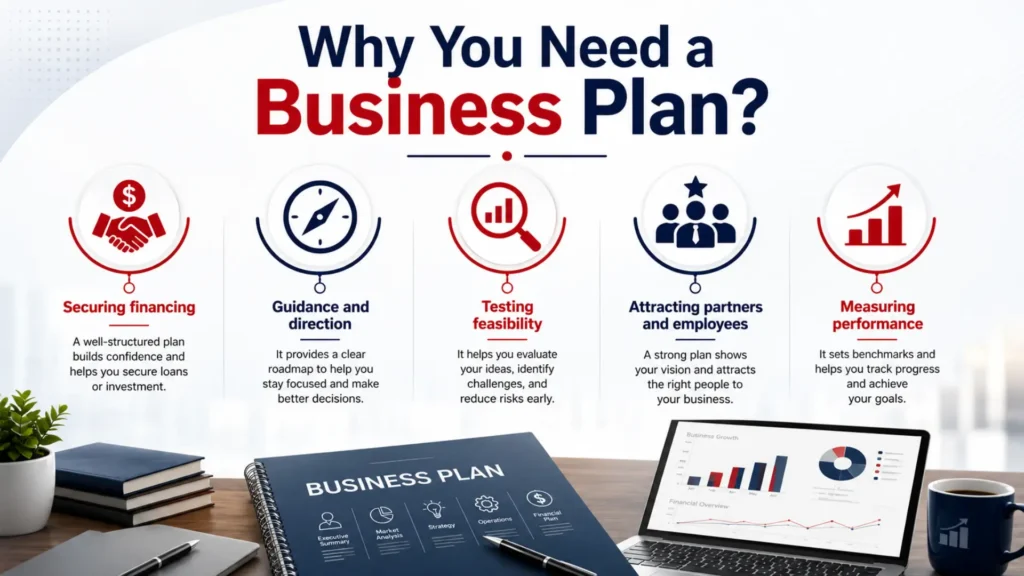
- Securing financing — Canadian banks, BDC, and private investors almost always require a business plan before releasing funds. It demonstrates you understand your market, your numbers, and your path to profitability.
- Guidance and direction — A business plan gives you a roadmap for decisions, helping you anticipate obstacles and spot opportunities before they become urgent.
- Testing feasibility — Writing the plan forces honest, researched thinking about whether the business idea actually works, before you spend money proving it in the market.
- Attracting partners and employees — A clear plan signals seriousness and vision, making it easier to bring in co-founders, strategic partners, or early hires.
- Measuring performance — Once your business is running, the plan becomes a baseline you can measure actual performance against and adjust from.
What Is Included in a Business Plan?
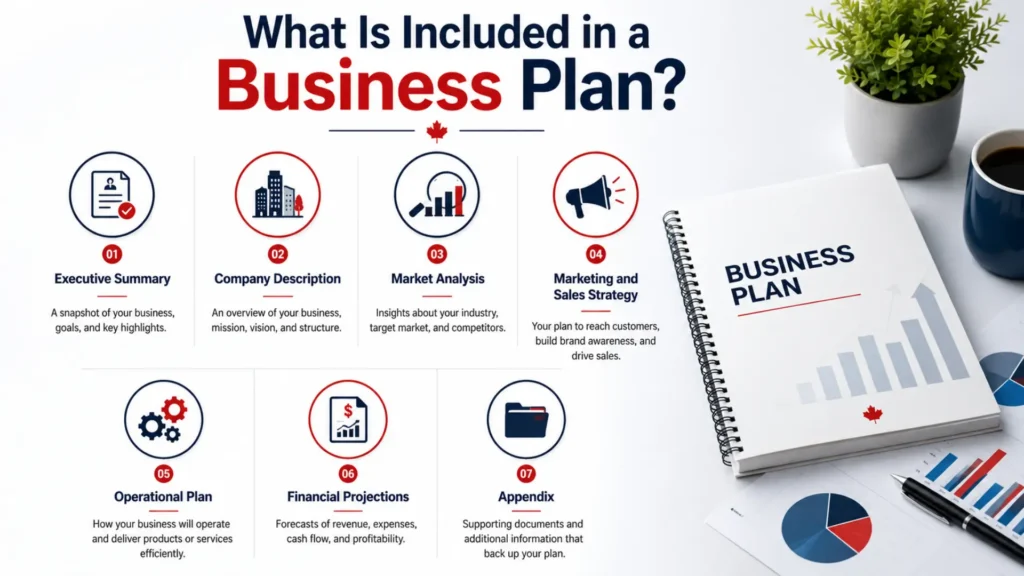
A complete business plan generally covers seven components:
- Executive Summary — A 1–2 page overview of the business, its opportunity, and what it’s asking for (funding amount, if applicable). Written last, even though it appears first.
- Company Description — Your legal structure, location, history, and what you sell.
- Market Analysis — The size and growth of your target market, your ideal customer, and your competitors’ strengths and gaps.
- Marketing and Sales Strategy — How you’ll reach customers: pricing, distribution, promotion, and sales process.
- Operational Plan — How the business runs day to day: supply chain, production or service delivery, quality control, staffing needs, and key partnerships.
- Financial Projections — Revenue and expense forecasts, cash flow, a break-even analysis, and a timeline for hitting financial milestones.
- Appendix — Supporting material: resumes, financial statements, market research, permits, or contracts.
Traditional vs. Lean Business Plans
Not every business needs the full 10–40 page document above right away.
Traditional business plan
The complete, detailed version above. Best when you’re seeking bank financing, BDC funding, or outside investors, since lenders expect full financial projections and market analysis.
Lean business plan
A condensed, often single-page version (sometimes built as a “business model canvas”) covering the same core categories at a glance: value proposition, customer segments, revenue streams, cost structure, and key activities. Best for testing an idea quickly, for internal alignment, or for early-stage startups whose model may still change.
If you’re not yet sure whether your idea needs full financing, start lean — you can always expand it into a traditional plan once you’re ready to approach a bank or investor.
Types of Business Plans
1. Startup Business Plan
Your priorities will determine how much emphasis you place on content. For example, a plan designed to secure funding will mainly rely on financial projections, whereas a plan designed for internal usage may prioritize operations and culture.
2. Feasibility Plan
Focused on a single product or service, testing whether it’s viable before full commitment. This is more important than most founders realize. According to CB Insights’ analysis of startup failures, about 42% cite no market need as a cause, and about 17% cite a product that simply wasn’t good enough. A feasibility study, run before you commit further time and money, is designed to catch exactly those issues early.
3. Internal Business Plan
Used by leadership to communicate goals, strategy, and performance across the company. Unlike an externally-facing plan built to raise capital, internal plans often include department-level budgets and target-specific action plans, and evolve as the business does.
4. Strategic Business Plan
Focused on long-term goals, typically covering 3–5 years, aimed mainly at internal stakeholders rather than lenders. It usually includes a resource assessment, your business’s mission and vision, and longer-range action plans to prepare for future challenges.
How to Write a Business Plan?
A business plan explains what your company does, who it serves, how it will operate, and how it will make money.
- Start by researching your target market, customer needs, market size, industry trends, and competitors. Use reliable data instead of assumptions, as this research will support the rest of your plan.
- Write the main sections in this order: company description, market analysis, marketing and sales strategy, operational plan, management structure, financial projections, and appendix.
- Prepare the executive summary last, even though it appears at the beginning. Keep it concise and highlight the business opportunity, target market, competitive advantage, growth strategy, and financial outlook. If you’re seeking funding, clearly state how much money you need and how it will be spent.
- Make use of accurate financial data, such as projected revenue, operating expenses, cash flow, and profit. Estimates that are too optimistic or ambiguous might damage your reputation with investors and lenders.
Free Business Plan Template
You can build your plan directly from a free, Canadian-oriented template — BDC and several provincial governments publish ready-to-use versions with example text built in:
Use any of these as a structural guide, but write the content yourself, based on your own research — a copied plan with someone else’s numbers or market analysis won’t hold up to a lender’s questions.
Not sure your numbers or structure will hold up to a lender’s scrutiny? Talk to Incpass before you submit — a quick review can catch gaps before a bank or investor does.
What Happens After You Write Your Business Plan?
Once your plan is done, the next steps are usually:
- Register your business in Canada — choosing your structure (sole proprietorship, partnership, or corporation) and making it official.
- Register for GST/HST if your revenue will exceed the small supplier threshold, or if you want to register voluntarily.
- Open a business bank account to keep your finances separate from personal accounts, which most lenders and accountants will expect regardless of your business size.
Conclusion
A business plan is ultimately an explanation of your business idea and the evidence behind why it will work. The more honest research and detail you put into it, the more useful it becomes — both as a tool to secure funding and as a working document you’ll actually return to as your business grows.
Contact Incpass for help turning your business plan into a registered, fully operational Canadian business.
FAQs
Do I need a business plan to register a business in Canada?
No, a business plan isn’t legally required to register a business in Canada. It is, however, almost always required if you plan to apply for a bank loan, BDC financing, or outside investment.
How long should a business plan be?
Most traditional business plans run 10 to 40 pages, with the executive summary kept to 1–2 pages. A lean business plan can be a single page.
Can I write my own business plan, or do I need a professional?
Using a template as a structural guide, you can create your own company plan. Before sending it to a lender or investor, many entrepreneurs decide to have it reviewed by an accountant, advisor, or business expert.
Do Canadian banks require a business plan for a loan?
Yes. Canadian banks and lenders, including BDC, typically require a business plan before approving business financing, since it demonstrates your understanding of the market and your ability to repay.
After completing my business strategy, what should I do?
The following step for most business owners is to register their company, apply for a business number and any necessary tax accounts (such as GST or HST), and open a business bank account.