
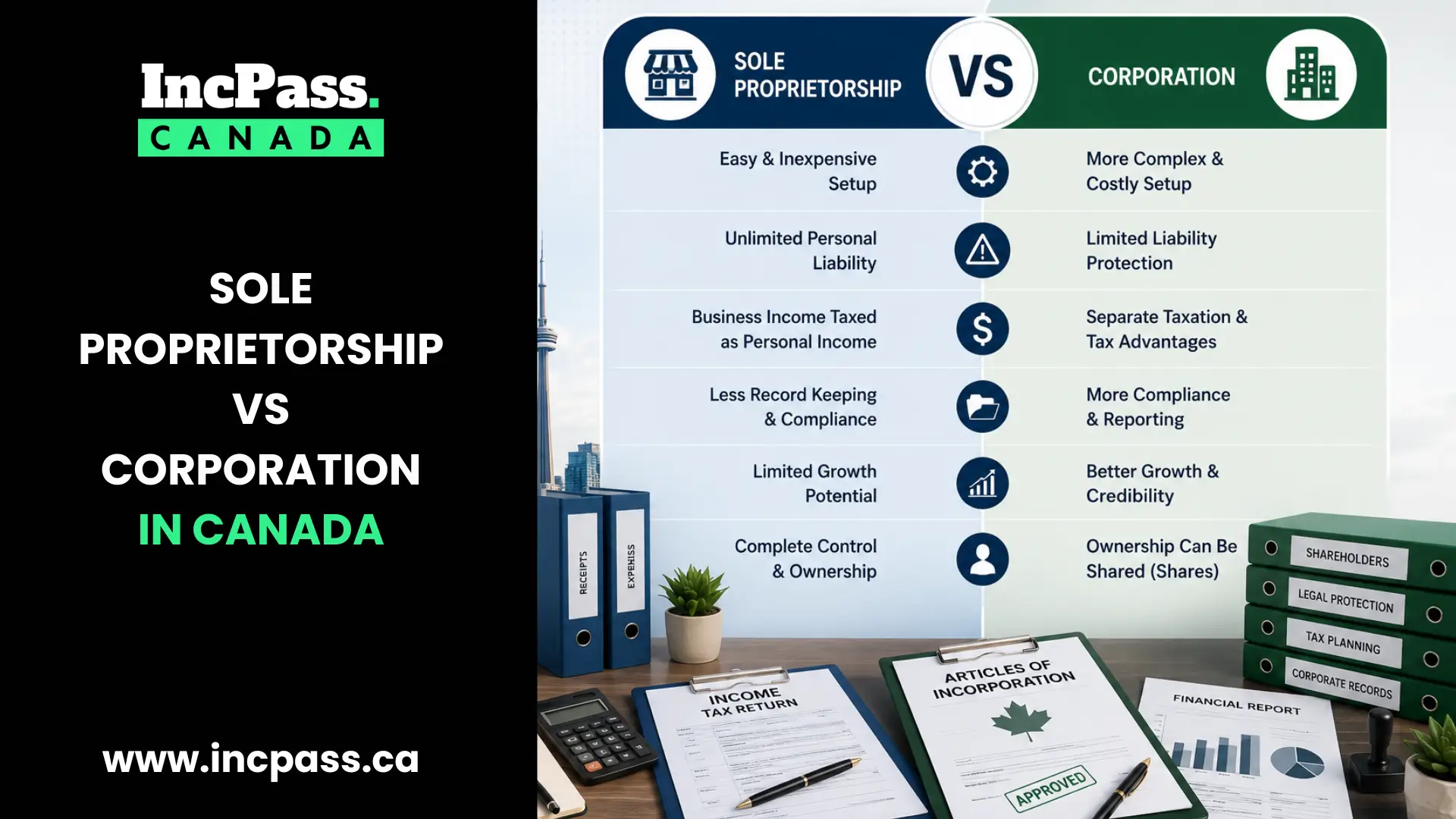

When you are beginning a business in Canada, among the initial and most significant choices you will make is to set up a sole proprietorship or a corporation.
The short answer: It’s easier to establish a sole proprietorship, but a corporation may be more tax efficient and provide better personal liability protection as your business expands.
But the best option is not one-size-fits-all. The decision is based on your income, your industry, your risk exposure, and your 5-year plan. This guide covers all the information you need to know about sole proprietorship vs corporation in Canada clearly, honestly, and without unnecessary jargon.
Sole Proprietorship vs Corporation in Canada: Comparison Table
| Feature | Sole Proprietorship | Corporation |
|---|---|---|
| Legal structure | The owner and the business are one | Separate legal entity |
| Personal liability | Unlimited | Limited to investment |
| Tax filing | Personal return (T1) | Separate corporate return (T2) |
| Setup complexity | Simple, low cost | More steps, higher cost |
| Tax rate | Personal marginal rate | Lower corporate rate |
| Income splitting | Not available | Possible (subject to rules) |
| Business continuity | Ends with the owner | Continues independently |
| Credibility | Basic | Stronger with clients/investors |
| Startup costs | Minimal | Moderate |
| Ongoing admin | Low | Medium to high |
What Is a Sole Proprietorship in Canada?
A sole proprietorship is the most common company structure available to Canadian business owners. You and the business are legally one and the same; there isn’t any legal separation of your personal and business finances.
Setting one up is straightforward. Depending on your province, you may need to register a business name, but there’s no federal incorporation process involved. You report all business income on your personal tax return using the T1 form.
This structure suits the following:
- Freelancers and independent contractors
- Early-stage entrepreneurs testing a business idea
- Low-risk, service-based businesses with modest income
- Business owners who want minimal administrative overhead
One genuine upside in early years: if your business operates at a loss, that loss can offset your other personal income, potentially reducing your overall tax bill.
What Is a Corporation in Canada?
A corporation is a legal entity that is separated from the individuals who own and operate it. It can sing and enter into contracts, own property, acquire debt, and be sure in its own name.
There are two ways you can incorporate: you can incorporate federally through Corporations Canada or provincially with your province’s business registry. Once the incorporation is finalized, you become a shareholder of the company and usually also a director and officer.
A corporation files its own tax return (T2), has a formal financial record, and is more structured than a sole proprietorship. That structure has significant benefits, in particular from a tax planning, personal protection, and long-term business building perspective.
This structure suits the following: advantages,
- Business owners with consistent, growing net income
- Anyone operating in a higher-risk industry
- Entrepreneurs seeking outside investment or partnerships
- Business owners planning to eventually sell their company
What Are the Key Differences Between a Sole Proprietorship and a Corporation?
The differences go well beyond paperwork. Here’s what actually matters in practice:
- Legal separation is the most fundamental distinction. A sole proprietor is the business. A corporation owns the business. This affects everything downstream: taxes, liability, investment, and succession.
- Taxation works differently in each structure. Sole proprietors pay tax on every dollar of business income at their personal marginal rate, which can climb steeply as income grows. Corporations pay tax at the lower corporate rate and give owners control over when they take personal income.
- Liability exposure is dramatically different. Sole proprietors face unlimited personal liability. The shareholders of a corporation are normally shielded from the business debts and liabilities of the company to the amount they have invested.
- The administrative burden is real for corporations, and they are required to file annual filings, corporate tax returns, resolutions of the directors, and registers of shareholders. Sole proprietors have far less to manage.
Which Business Structure Pays Less Tax in Canada?
If comparing sole proprietorship and a corporation taxes in Canada, the corporation is the more tax-efficient structure, particularly if you’re earning a significant income.
All your net business income is added to your personal return and taxed at your marginal rate as a sole proprietor. The more you earn, the more you pay, with no flexibility around timing.
Corporations, particularly Canadian-controlled private corporations (CCPCs) that qualify for the Small Business Deduction, are taxed at a significantly lower rate on active business income up to the threshold.
More importantly, corporations let you control when you pay personal tax. If the business earns more than you need this year, you can leave earnings inside the company, deferring personal tax until you choose to withdraw. Over the years, that deferral can compound into a meaningful financial advantage.
Sole proprietors have no equivalent option. Every dollar earned is taxed in the year it’s earned.
Bottom line: If your business income consistently exceeds your personal spending needs, a corporation almost always offers better tax outcomes.
How Does Liability Protection Differ Between a Sole Proprietorship and a Corporation?
There is no legal barrier between you and your business as a sole trader. A client lawsuit, an unpaid supplier, or a business debt can reach your personal savings, your home, your vehicle, and everything.
A corporation creates that wall. If the corporation faces a legal claim or debt, your personal assets are generally protected. Shareholders typically risk only their invested capital.
This protection has limits; personal loan guarantees or director negligence can sometimes override it, but for everyday business risk, the protection is real and significant.
Industries where this matters most:
- Construction and contracting
- Healthcare and wellness
- Consulting and professional services
- Food and hospitality
- Any business that signs client contracts or employs staff
For anyone with meaningful personal assets or working in a higher-exposure field, liability protection alone is often the deciding factor in choosing to incorporate.
When Should You Incorporate Your Business in Canada?
Timing matters. These are the strongest indicators that it makes sense to incorporate:
- Your net income exceeds your personal living expenses: the surplus can sit inside the corporation at a lower tax rate
- You’re taking on contracts, clients, or employees: liability risk is on the rise
- You need investors or partners: corporations are built to share equity
- Clients in your industry expect it: government, finance, and enterprise clients are often interested in or need incorporated vendors
- You’re building something to sell: a corporation has assets and goodwill in a structure that is intended for sale or transfer
When you’re just beginning out with a low income, it makes sense to remain a sole proprietor until you build up your business. The object is to identify the inflection point before the cost of delay becomes too great.
What Are the Pros and Cons of a Sole Proprietorship in Canada?
Here are the sole proprietorship pros and cons:
Pros:
- Low cost and fast setup
- Filing an easy tax return through your personal return
- Company losses offset by personal income
- Requires less administrative work and fewer ongoing filing obligations
- Complete decision-making control
Cons:
- Unlimited personal liability; your assets are exposed
- All income is taxed at personal marginal rates
- No income deferral or splitting options
- Low credibility with the biggest clients or lenders
- A business doesn’t survive the owner
What Are the Pros and Cons of a Corporation in Canada?
Here are the corporation’s pros and cons:
Pros:
- Limited liability protects personal assets
- Reduce the rate of corporate taxes on business income
- Ability to defer personal taxes by retaining earnings
- Income splitting with family shareholders (under the TOSI rules).
- Greater credibility and better financing opportunities
- Business runs independently of the owner
Cons:
- More expensive setup and complicated registration
- Continuing compliance and administrative needs
- It is required to submit a separate corporate tax return each year
- Business losses can’t directly offset personal income
- More accounting fees year-round
Common Mistakes to Avoid When Choosing a Business Structure
Even well-intentioned business owners get this wrong. Here’s what to watch out for:
1. Incorporating too early: If your income is still relatively low and your risk is low, the extra expense and paperwork of a corporation may not be justified yet; timing matters.
2. Staying a sole proprietor for too long: Many entrepreneurs start as sole proprietors, but a growing business may benefit from the protections and opportunities that come with incorporation.
3. Choosing based on setup cost alone: The incorporation fee is a single-time cost. Corporation tax and liability benefits accrue over the years. Think long-term.
4. Not getting professional advice: A discussion with a Canadian accountant or business lawyer prior to deciding can save thousands of dollars in avoidable mistakes, particularly in timing and structure.
5. Ignoring provincial differences: Business registration rules, corporate tax rates, and compliance requirements differ across provinces. What applies in Ontario may differ in British Columbia or Alberta.
Conclusion
The sole proprietor vs corporation debate in Canada doesn’t have a universal winner; it has a right answer for your specific situation.
If you’re early-stage, low-risk, and keeping overhead tight, a sole proprietorship is a perfectly reasonable starting point. But if your business is gaining traction, your income is growing. And you’re thinking about the future; a corporation gives you the tools to protect what you’re building and keep more of what you earn.
Most successful Canadian business owners incorporate at some point. The question isn’t whether it’s when. When you are ready to explore incorporation, or you want to know which option is right for you, Incpass.ca will make the process simple. From federal and provincial incorporation to ongoing compliance support, Incpass helps Canadian entrepreneurs get set up right without the confusion or the legal runaround.
FAQ’s
Can a Sole Proprietor Become a Corporation Later?
Yes. A Section 85 rollover is available under the Income Tax Act to incorporate at any time and transfer business assets to the new corporation, sometimes without paying any tax. This is a typical growth phase for expanding Canadian companies. Working with an accountant ensures the process is handled correctly.
Is It Better to Be a Sole Proprietor or a Corporation in Canada?
It will be based on your situation. Early-stage companies find it easier and more affordable to be sole proprietorships. A corporation offers better tax efficiency and liability protection as income grows. Most Canadian business owners find that incorporation becomes the smarter choice once their business is consistently profitable and carrying real-world risk.
Do Corporations Pay Less Tax in Canada?
Generally, yes. Corporations, especially qualifying Canadian-controlled private corporations, are taxed at a lower rate than most personal income tax brackets. The added advantage is control over timing: you can leave earnings inside the corporation and defer personal tax until you choose to withdraw funds.